


When should wellness brands shoot their January 2027 content?
Shoot January's first two weeks in December, ideally before Christmas. New Year's Day 2027 is Friday 1 January, and "Quitter's Day" has been reported anywhere from 10 to 19 January. On Dream Aspect's typical 7–10 days from shoot to delivery, in calendar days, day-one posts going up by Tuesday 29 December need a shoot by 19–22 December, and a Monday 4 January shoot lands on 11–14 January.
January 2027 at a glance:
- Quitter's Day: no fixed date, so plan for the window Friday 8 to Tuesday 19 January.
- How fast resolutions fade: in a 1989 study, 77% held at one week and 55% at one month.
- Last live-action shoot for day-one posts: Saturday 19 to Tuesday 22 December, to post by Tuesday 29 December; that is first delivery, before booking, approvals and legal review.
- A 4 January shoot: delivers typically 11–14 January, for content from week three.
- The claim rule: health claims need substantiation, and Meta and TikTok restrict weight-related ads to adults.
When does New Year's resolution season start and end in 2027?
New Year's resolution season 2027 runs from Friday 1 January, New Year's Day on the federal holiday schedule, to Sunday 31 January, when the 31-day Dry January® and Veganuary challenges end if Alcohol Change UK and Veganuary run them as in 2026. Inside it sit the first working Monday (4 January), the two Quitter's Day conventions (Friday 8 and Tuesday 12 January) and the Martin Luther King Jr. Day weekend, 16–18 January, with Monday 18 a federal holiday.
For content makers the season starts earlier. Meta's August 2026 holiday guidance names a "fresh start phase (Late December / New Year)" and says "This phase is all about the self-purchase." That is the framing of a company that sells the ads, not a measurement.
When do New Year's resolutions actually drop off?
New Year's resolutions fade gradually, not on one day. In a 1989 study of 200 resolvers, summarised in PLOS ONE in 2020, 77% were still keeping their resolution after one week, 55% after one month, 43% after three months, 40% after six months and 19% after two years. So plan a sequence across January, not one rescue post. Nothing we found tests whether a January posting day changes sales.
The PLOS ONE paper's own experiment recruited 1,066 Swedish-speaking people in late December 2016 and reports: "The most popular resolutions regarded physical health, weight loss, and eating habits." A year on, 55% of those who responded considered themselves successful. The sample was self-selected, three authors earn royalties from a book on resolutions, and the experiment randomized support for resolvers: it measured resolutions, not ads.
Placer.ai, which sells foot-traffic data, estimates that "Fitness visits in January 2025 were 21.2% higher than in December 2024" (23.4% for January 2024), but monthly data cannot date a fall inside January, and we found no weekly U.S. series. The claim that 80% quit by mid-February appears, in the reports we read, only in one 2025 article that names no source, so this calendar does not use it.
When is Quitter's Day 2027, and is it a real date?
Quitter's Day has no fixed date. Eight press reports, the earliest dated December 2018, place it anywhere from 10 to 19 January, on every weekday except Wednesday. The two current conventions, the second Friday and the second Tuesday, give Friday 8 and Tuesday 12 January 2027; the 8th is the earliest a second Friday can fall, because New Year's Day is a Friday. Our reading: a real pattern in Strava's data, published as a moving media date.
The eight reports and their dates:
- Fox News, from News.com.au (31 December 2018): Saturday 12 January 2019, from 31.5 million Strava activities.
- endurance.biz (16 January 2020): Sunday 19 January 2020, and Thursday 17 January 2019 looking back.
- BikeRadar (6 January 2020): Sunday 19 January 2020, Strava's announced prediction.
- Sticky Bottle (undated, about 2020): Sunday 19 January 2020, from global workout trends.
- Yahoo (17 January 2022): Monday 17 January 2022, and Friday 15 January 2021 by its arithmetic, from 12 months of athlete data.
- Fusion Media (year not stated): Friday 12 January in the UK, from Strava workout data.
- TechRadar (8 January 2025): Tuesday 14 January 2025, the "second Tuesday", attributed to Strava.
- Gadgets & Wearables (19 January 2025): Friday 10 January 2025, the "second Friday", with no source given.
The Quitter's Day reports disagree: the two 2019 dates differ by five days, and two 2025 reports, eleven days apart, use different conventions. In 2020 two reports carried one quotation, naming 19 January, from Strava's UK country manager, Gareth Mills. On 5 October 2026 Strava's press-site sitemap did not contain the word quitter or resolution, though the same search found a known January 2023 release; not found is not never published. A London PR agency's case study describes using Strava's data "to create a national news moment".
When does January wellness content have to be shot?
Day-one posts need a live-action shoot by 19–22 December 2026, and Quitter's Day posts one by 28–31 December. The dates count back from Dream Aspect's published window, "Full content delivery typically takes 7-10 days after the content shoot day", in calendar days through Christmas Day and New Year's Day, and exclude booking, approvals and legal review.
Deadlines by posting date:
- Day one, New Year's Day (Fri 1 Jan): post by Tue 29 Dec; live-action shoot by Sat 19 – Tue 22 Dec; simple 2D brief by Thu 24 – Sun 27 Dec; complex 3D brief by Sun 29 Nov – Tue 15 Dec.
- First working Monday (Mon 4 Jan): post by Mon 4 Jan; shoot by Fri 25 – Mon 28 Dec; simple 2D brief by Wed 30 Dec – Sat 2 Jan; complex 3D brief by Sat 5 – Mon 21 Dec.
- Quitter's Day window (from Fri 8 Jan): post by Thu 7 Jan; shoot by Mon 28 – Thu 31 Dec; simple 2D brief by Sat 2 – Tue 5 Jan; complex 3D brief by Tue 8 – Thu 24 Dec.
- Third week, before the MLK weekend: post by Fri 15 Jan; shoot by Tue 5 – Fri 8 Jan; simple 2D brief by Sun 10 – Wed 13 Jan; complex 3D brief by Wed 16 Dec – Fri 1 Jan.
- Challenges end (Sun 31 Jan): post by Thu 28 Jan; shoot by Mon 18 – Thu 21 Jan, Monday 18 being a federal holiday; simple 2D brief by Sat 23 – Tue 26 Jan; complex 3D brief by Tue 29 Dec – Thu 14 Jan.
Ranges run from safe to fast: simple 2D takes 2–5 days for a 7–12-second piece and complex 3D 2 weeks to 1 month, counted from an approved brief because Dream Aspect's CGI page does not say when its clock starts. UGC is left out on purpose: the UGC page gives two unreconciled timelines, "14 to 30 days" and "as short as 7 days".
Dream Aspect's pages do not say whether the 7–10 days count weekends and holidays. If they do not, or nobody works between 24 December and 3 January, every date moves earlier, and one shoot by 19–22 December has to serve the first three posting dates. Confirm in writing any delivery due that week, from anyone. Early dates also sell December bookings, which is why every range shows both ends, the later a best case.
What does a shoot on 4 January still buy?
A shoot on Monday 4 January 2027 typically delivers 11–14 January, in calendar days and before your approval round: inside the Quitter's Day window, at best in time for the second Tuesday, and one to four days before third-week posts on Friday 15 January. Book the first January shoot for content from week three, and re-cut any December footage for the first two weeks.
Post ahead of each date. Metricool measured that "70% of total views on Instagram happen in the first three days", 65% for Reels, across 24,364,803 January–February posts. Read it as a ceiling; Metricool sells social software. So day-one and end-of-challenge posts go up three days early, Quitter's Day and third-week posts the day before, and first-Monday posts open their own week.
What health claims can a supplement or fitness ad make in January?
A supplement or fitness ad can make only claims you can substantiate, and for a health benefit the FTC generally expects "randomized, controlled human clinical testing". This summarises public guidance as of 5 October 2026; it is not legal advice, and prescription weight-loss products, state law and non-U.S. markets were not checked.
The FTC's Health Products Compliance Guidance (December 2022) says customer anecdotes, "including surveys of consumer experiences, are never sufficient to substantiate claims about the effects of a health product". Testimonials should not carry claims that "couldn’t be substantiated if the advertiser made them directly", and "Results not typical" does not cure a dramatic one. Paid reviews must disclose the payment. The FTC has acted against marketers and, "in appropriate circumstances", against ad agencies, so making the ad does not put you outside the guidance.
Pictures are claims too. The FTC's Example 1 is a weight-loss brochure whose images of lab-coated doctors and "molecular structures", it says, "likely convey an implied claim that the product has been clinically proven to be effective for weight loss." That is uncomfortable for Dream Aspect to print, because we make CGI: no production company can fix an ad whose claim lacks the evidence, and the molecule shot that makes a supplement look scientific is, in the FTC's own example, likely to say it has been clinically proven.
What the FTC guidance means on set:
- CGI molecule animation: Example 1 says it likely implies "clinically proven", so animate use, or only what the evidence supports.
- Testimonial with a dramatic result: it should come with a clear disclosure of what a typical consumer can expect, so show the routine and the effort.
- Citing a study whose subjects also dieted and exercised: Example 8 says the ad "should make clear that users of the supplement also will need to reduce calories and engage in regular exercise", so make diet and exercise part of the message.
- Paid creator: the payment must be disclosed, so script the disclosure before the shoot.
Supplement labels follow separate rules. The FDA's labeling guide, dated 2005, governs labels: substantiation, the standard disclaimer, and notice to the FDA "no later than 30 days after the first marketing of the product". The FTC says those label rules "don’t govern the FTC’s assessment of those claims in advertising".
What do Meta's and TikTok's 2026 health-ad rules mean for January creative?
Meta and TikTok both restrict weight-related ads to adults, and both bar a form of the product-alone claim: TikTok for weight products generally, Meta for wearables. Meta's Health and Wellness policy carries a change log dated 22 July 2026; TikTok's Weight Management and Body Image policy reads "Last updated: September 2026", and TikTok also published a May 2026 update to it. Earlier versions were not read. Both pages were revised in 2026, so re-read them before launch.
- Age: Meta requires diet, health and weight product ads to target people "at least 18 years or older"; TikTok allows weight claims to 18+ "via the promotion of a healthy lifestyle".
- Product alone: Meta bars "Claims that results can be achieved solely by using wearable products"; TikTok bars "Claims that the product alone, without diet or exercise, can lead to weight loss or muscle gain."
- Appearance: Meta bars "statements of inferiority about physical appearance" and a "Close up on specific body area by pinching fat"; TikTok bars claims that a look makes people "more desirable, successful, happy, or popular".
- Time and ease: Meta bars timeframe promises "without disclaimers or qualifiers" and lets 18+ ads show "the time taken to achieve noticeable results"; TikTok bars suggesting weight loss "is easy or guaranteed".
- Exempt or allowed: Meta keeps products "marketed for general wellbeing, such as fitness services and equipments, health clubs", and "protein products" outside its age rule; on TikTok, weight loss supplements "may be allowed" in the U.S. and Canada.
The FTC, Meta and TikTok point the same way: TikTok bans the product-alone claim outright, Meta bans it for wearables, and the FTC says an ad citing a study whose subjects also dieted and exercised should make that clear. So never let a January ad imply the product works on its own. Meta's exemption also turns on marketing: an equipment ad "marketed for general wellbeing" is outside the age rule, but sell the same equipment on weight loss and it promotes a "weight loss or weight gain" product, which must target 18+. Plan cuts per claim.
How should brands use Dry January and Veganuary in their content?
Brands should treat Dry January® and Veganuary as the charities' own 31-day challenges, Friday 1 to Sunday 31 January 2027 if they run as in 2026, and the two charities treat brands differently. Dry January® is a registered trademark of Alcohol Change UK, which asks that references be "only used to describe people signing up to take part in the Dry January ® challenge by Alcohol Change UK". Veganuary says "Participation in Veganuary is completely free!"
- Brand route: Dry January® has an official partner programme, for example "Official Beer of the Dry January® challenge"; Veganuary offers "logos, graphics and other assets for free to show your involvement".
- Size, as published: 17.5 million UK adults (32%) planned a month off in January 2026, according to two Censuswide polls of 2,000 UK adults for Alcohol Change UK in November 2025; Veganuary counts "roughly 30 million people worldwide" across twelve countries, by Veganuary's own calculation.
- U.S. footprint: the Alcohol Change UK pages read give no U.S. figure; Veganuary says "Over 2,000 restaurant locations celebrated Veganuary in the US in 2026".
- Goal type, our reading: Dry January® is avoidance (stop drinking); Veganuary is approach (try vegan).
Both size figures are weak: a UK intention poll and a self-reported, extrapolated count. The goal-type split is our inference: PLOS ONE found approach goals more successful in its Swedish-speaking sample, 58.9% to 47.1%, so Dry January® content should probably show what people start, such as the alcohol-free drink, not what they give up. Treat that as a reason to test, not proof.
On the Dry January® mark: call it Alcohol Change UK's challenge, use ® on first mention, and keep it out of your campaign names unless you are a partner. The mark's U.S. status was not checked, and this is not legal advice.
What should each week of January content say?
Each week of January 2027 gives a wellness brand's content a different job: start, prove, keep going, restart, then what next. Show the routine and the effort, never a promised result. Example lines are ours.
- Fri 1 – Sun 3 Jan, start: "Day one: the first ten minutes", as a how-to Reel or carousel. Claim risk: an outcome by a date.
- Mon 4 – Thu 7 Jan, prove: "What week one actually looks like", as a day-in-the-life without results. Claim risk: before-and-after, or calling it easy.
- Fri 8 – Tue 19 Jan, keep going: "Bring someone to Saturday's session", as community posts and small wins. Claim risk: shame or quitter framing.
- Fri 15 – Mon 18 Jan, restart: "Start again on Tuesday", as a simple 2D reminder. Claim risk: the product doing the work.
- Wed 20 – Sun 31 Jan, what next: "Keep the habit after the 31 days", as a routine after January. Claim risk: timeframe promises.

The keep-going job has backing: in PLOS ONE the group given some support did significantly better, and Strava's tips, as reported in 2020, began "People keep people active: Find a friend or join a club to help keep motivated." Two lines we would cut from any January brief: "Don't be a quitter", avoidance framing aimed at those most likely to feel it, and "Results in 30 days", a timeframe promise Meta bars without qualifiers.
What does a wellness brand's content look like after January?
After January, a wellness brand's content runs year-round. Dream Aspect's case study of a wellness brand on Instagram in 2025 ("Client: fitness accessory brand") describes "year-round content production" for organic and paid social, and reports no January result. The brand was losing its 18–25 audience "despite consistent content posting"; the method used "edutainment" to "increase watch time" and carousels for "capturing non-follower views and reach". Over 2025 views rose 350%, Instagram shares 94%, and annual follower growth was 20% against the client's 15% goal.
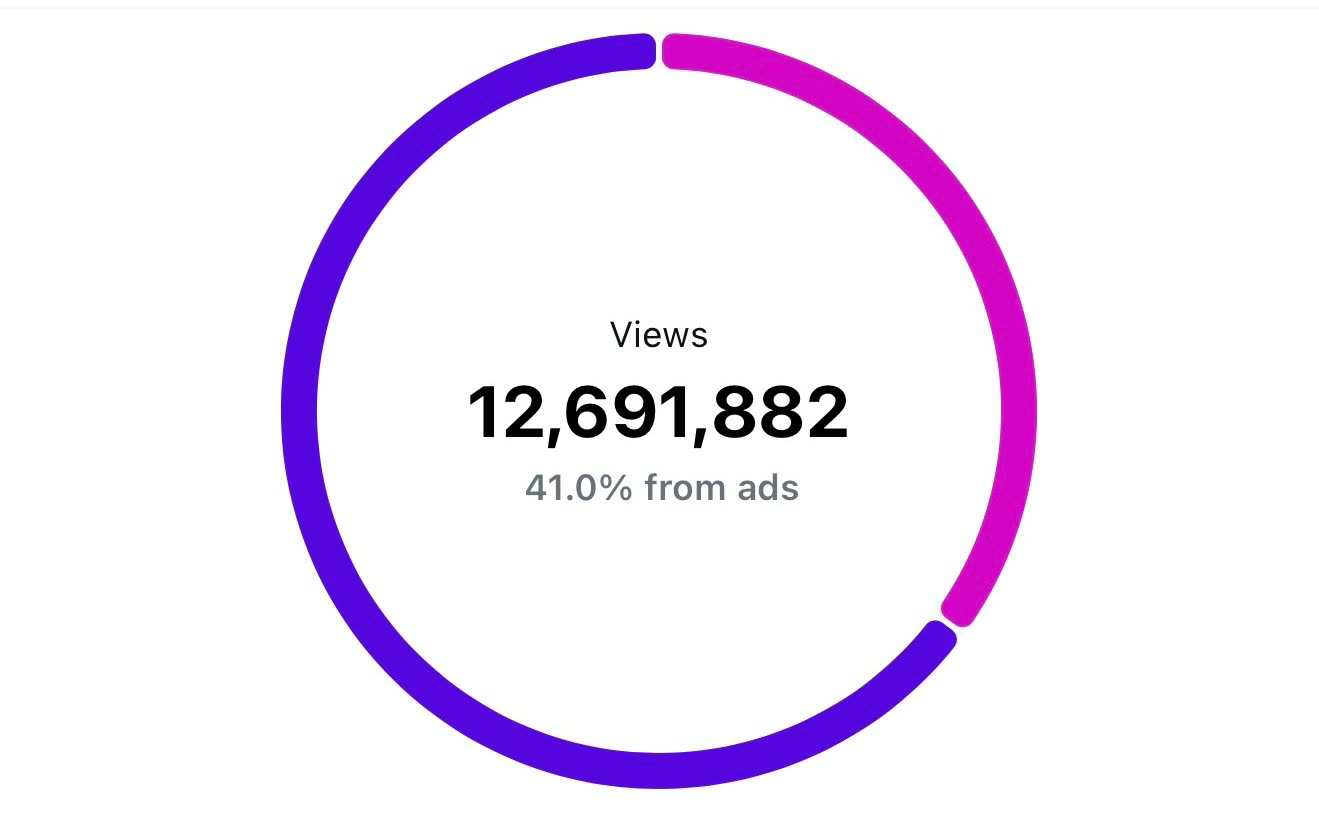
A material share of those views was paid: the case study says "Organic contributed to 60% of views (40% from ads)", and Dream Aspect's homepage has published 38.6% and 41% elsewhere, unreconciled. The headline's absolute figures do not match its published growth rate, so we use only relative figures, as does our format-strategy article.
The case against buying more: a brand that sells mostly in January can reasonably buy only the December shoot. For the steady state, see how many videos a month a brand actually needs.
Planning January wellness content from Los Angeles?
Dream Aspect is a video production company in Los Angeles. Book a half or full content day, delivered typically 7–10 days after the shoot day, or brief a CGI product video; we also make UGC. The last day to book comes before the last day to shoot, so ask for it with the quote. If your January claim is not yet substantiated, start with your lawyer, not us; if it is, send us your posting dates.
Want a price for January wellness content before you brief it? The Dream Aspect pricing calculator shows the price on the page: choose a one-off shoot or a monthly plan, then add or remove deliverables such as a shoot brief, priority delivery, CGI or UGC.
Build your quote on the pricing page →
Prefer to talk it through? Talk to us → or book a 15-minute call from the pricing page.
Key takeaways
- Eight reports, the earliest dated December 2018, have placed "Quitter's Day" between 10 and 19 January; the two conventions give Friday 8 or Tuesday 12 January 2027.
- On Dream Aspect's typical 7–10 days, counted in calendar days, day-one posts going up by 29 December need a shoot by 19–22 December; booking, approvals and legal review come on top.
- In one study of 200 resolvers, 77% still kept their resolution after one week and 55% after one month, so plan a sequence across January, not one post.
- The FTC's December 2022 guidance generally expects randomized, controlled human clinical testing for a health claim, and its own example says molecule images can imply "clinically proven".
- Meta's and TikTok's 2026 policies restrict weight-related ads to people 18 and over; TikTok also bars implying the product alone gets results, and Meta bars that claim for wearables.
Frequently asked questions
When is Quitter's Day 2027?
There is no fixed date. Eight press reports, the earliest dated December 2018, have placed "Quitter's Day" between 10 and 19 January, on six different weekdays. The two conventions give Friday 8 January 2027 (second Friday) or Tuesday 12 January 2027 (second Tuesday). Plan for the window Friday 8 to Tuesday 19 January rather than for a single day.
When do most New Year's resolutions fail?
Gradually, not on one day. In a 1989 study of 200 resolvers, reported in PLOS ONE in 2020, 77% held at one week, 55% at one month and 40% at six months. In that paper's own experiment, of the 1,066 who signed up, 55% of those who answered a year later said they had kept it (a Swedish-speaking, self-selected sample).
When should a supplement brand shoot its January content?
Before Christmas if you can. On Dream Aspect's typical 7–10 days, counted in calendar days, posts going up by Tuesday 29 December for 1 January 2027 need a shoot by 19–22 December, and Quitter's Day posts need one by 28–31 December. That is first delivery only; booking, approvals and legal review come on top.
Can a supplement ad say it helps you lose weight?
Only if you can substantiate it. The FTC's December 2022 guidance says health benefits generally need randomized, controlled human clinical testing, and anecdotes are "never sufficient". If the study's subjects also dieted and exercised, the FTC says the ad should make that clear. Meta and TikTok also require 18+ targeting. This is not legal advice.
Can a January ad show before-and-after results on Meta?
Not clearly. Meta lets 18+ ads for weight products show the product in use, its impact and "the time taken to achieve noticeable results". It allows before-and-after for general cosmetic products but does not address weight-loss before-and-after directly. The FTC adds that a testimonial showing more than users can generally expect should disclose the typical result.
Is it too late to shoot in January for January?
Too late for the first two weeks, not for the rest. Counted in calendar days, a shoot on Monday 4 January 2027 typically delivers 11–14 January, inside the 8–19 January Quitter's Day window and one to four days before third-week posts on Friday 15 January, before booking, approvals and legal review. If you have December footage, re-cut it instead.
Can a brand use the name Dry January in its campaign?
Only with care. Dry January® is a registered trademark of Alcohol Change UK, which asks that the name describe people signing up to its challenge. Call it Alcohol Change UK's challenge, use ® on first mention, and keep it out of campaign names unless you are a partner. Veganuary is free to join and offers free logos and assets. This is not legal advice.
Sources
TikTok
Alcohol Change UK
BikeRadar
Endurance Business Media
Meta
US Food and Drug Administration
Fox News
US Federal Trade Commission
Fusion Media
Gadgets & Wearables
- Strava's New Year's resolutions data — 19 January 2025
PLOS
Metricool
Yahoo News
Placer.ai
Strava
Stickybottle
TechRadar
US Office of Personnel Management
Veganuary
- Business participation
- Veganuary celebrates 30 million global participants: 2026 campaign proves plant-based isn’t goi
Dream Aspect


