


How did a wellness brand grow Instagram views 4.5x?
By changing strategy, not volume. Over 2025, the brand's Instagram views grew 4.5x (up 350%), Instagram shares rose 94% and TikTok shares rose 475%, after Dream Aspect ran a 72-slide strategy audit, shifted the content to an Entertain → Educate thesis and bet on carousels for non-follower reach. Roughly two fifths of the views were paid, so this was never an organic-only result.
- Instagram views: up 350%, a 4.5x increase
- Instagram shares: up 94%
- Instagram engagement: up 58.31%
- Instagram follower growth: 20% annually against a 15% goal
- TikTok likes: 236,756, up 577%
- TikTok shares: 11,422, up 475%
- TikTok net-new follower growth: 85.7%
How much of the view growth was paid?
A material share: roughly two fifths. Dream Aspect's case study of a wellness brand from 3.2M to 14.8M on Instagram puts the paid contribution at 40%, and Dream Aspect's homepage shows 38.6% and 41% in different reporting tiles, as of 5 October 2026. We have not reconciled the three, so we do not quote one as definitive, and we do not rely on that headline before-and-after figure here because the page does not state clearly enough which metric it counts. Engagement growth has the same problem: 58.31% in the case study and 58.41% on the homepage, so we use the lower number.
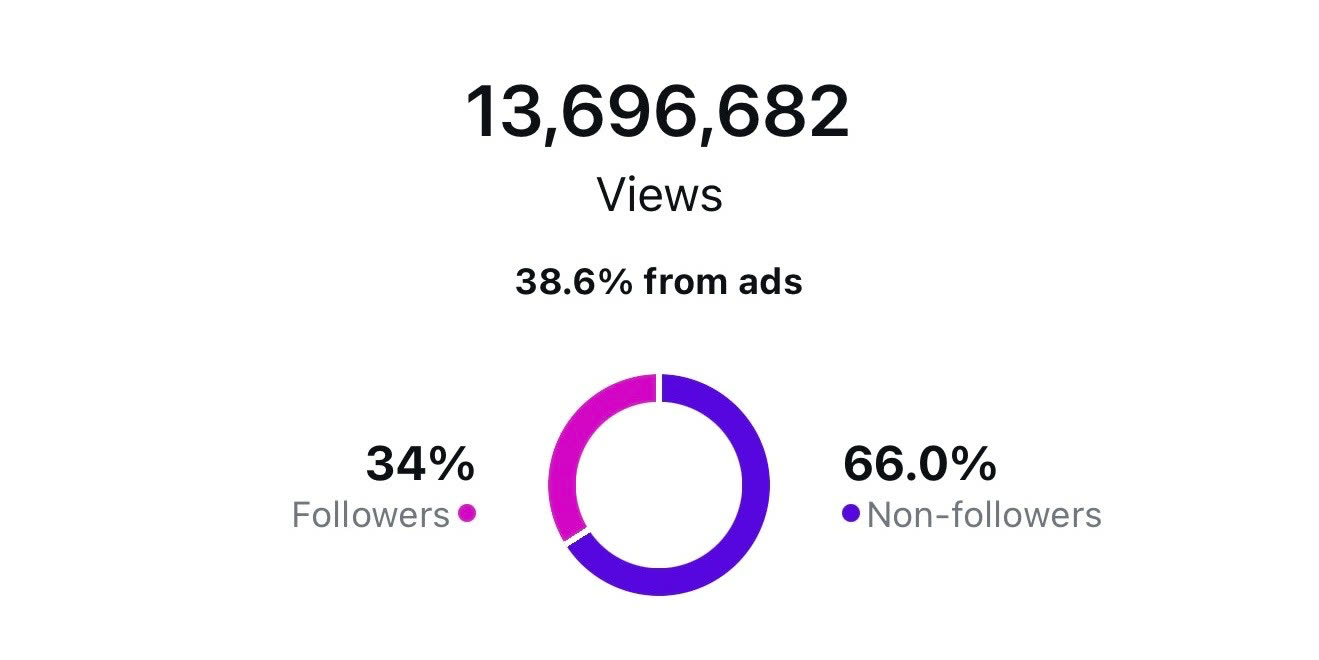
All of this evidence is first-party and self-reported: our engagement, our numbers and no external audit. It covers one brand, one category and one year. We have not run a controlled test, there is no counterfactual brand, and the case study does not isolate any single format from everything else that changed during 2025, including paid media. A format argument is necessarily weaker when a large part of the distribution was bought. To test claims like these on any agency's page, see how to check an agency's results claims.
What was the starting problem?
The brand had an established, still-growing Instagram following but was losing relevance with its 18–25 audience. Dream Aspect's case study describes “a steady decline in engagement, despite consistent content posting”. So the brand was already doing what most advice prescribes, posting consistently, and it had not stopped the decline. That is why Dream Aspect treated it as a relevance problem rather than a volume problem. If your own numbers are sliding, our guide to why Instagram engagement is declining covers the wider causes.
Why start with a strategy audit instead of a shoot?
Because a declining brand often has a diagnosis problem before it has a production problem, and a shoot commissioned against the wrong diagnosis is an expensive way to publish more of what is already failing. Dream Aspect's audit was a 72-slide content-strategy deck that, in the case study's words, covered “everything from the brand’s new visual language and tone of voice to detailed customer psychographics.” Its purpose was to answer one question: what is this content giving the person watching it in exchange for their attention? We have not published the full deck, so anything beyond the case study's description is our own account.
The symptoms a declining brand reports all sound like production problems, and often they are not. The audit's job is to separate each symptom from the reason the audience stopped caring:
- Engagement is down.
- We do not know what to post.
- Trends are not working.
A brand that cannot say in one sentence what its content gives the viewer may not have a production problem at all. It may have a positioning problem wearing a content problem's clothes.
What is the Entertain → Educate content thesis?
Entertain → Educate is the edutainment emphasis Dream Aspect used: the case study says the strategy emphasised it to expand the brand universe and increase watch time. Watch time is not a vanity target. Instagram's Instagram Ranking Explained names the likelihood that someone will watch a Reel all the way through among its important Reel-ranking predictions. Why the order matters is our interpretation: education first can feel like instruction, which an audience that did not ask to be taught may read as advertising, while education after attention has been earned feels like a reward for staying. The case study does not test that experimentally, and several things changed during the engagement.
Why did Dream Aspect bet on carousels in a video-first year?
Because the job Dream Aspect gave carousels was reaching people outside the existing following. The case study calls carousels the “secret weapon for capturing non-follower views and reach”. That was deliberately contrarian: Socialinsider reports that brands increased Reels posting by 33% year over year. Instagram's ranking explainer, published in 2023, describes Reels as the surface where people mostly see accounts they do not already follow. Feed also includes recommended content, but Instagram publishes no comparable percentage for it. So the bet that carousels were the right vehicle for non-follower reach was ours, and the vendor evidence splits on it.

Do carousels beat Reels on Instagram?
There is no universal answer in the benchmark data. Socialinsider's 2026 benchmark analysed 35 million Instagram posts from 447,613 pages active between January and December 2025 and calls carousels Instagram's strongest format on several measures, at about 0.55% engagement per post by followers against roughly 0.52% for Reels. That 0.03 percentage-point gap is too small to justify a universal strategy, and Socialinsider measures likes and comments divided by followers, which says nothing about the non-follower reach our carousels were meant to win. Socialinsider is also an analytics software vendor. For benchmarks by platform, size and format, see what counts as a good engagement rate.
Metricool points the other way on discovery. Its 2026 Instagram study of 24,364,803 posts from more than 375,000 accounts recommends Reels for reaching new audiences, according to Metricool's study release, which also reports single-image engagement down 45.98%. Metricool, which sells a social-media management platform, found in its Instagram trends analysis that:
- Reels perform better on most major measures.
- Reel engagement rose 24.76% year over year.
- Carousels get nine times more saves than single-image posts.
- Carousel average views were about 1.69% higher than Reels.
On discovery, the question that mattered for this strategy, Metricool gives the stronger case to Reels. So the honest conclusion is narrow: carousels were the right bet for this brand, in this category, during this period. That is not a claim that carousels are the best Instagram format.
Which Instagram metric should you watch: views or reshares?
Reshares, if you are choosing a mechanism to optimise around. Instagram's ranking explainer lists the likelihood that someone will reshare a Reel among its important Reel-ranking predictions, alongside watching to the end, liking and visiting the audio page, though it publishes no numeric weights. Treat it as Instagram's own explanation, not a neutral one: Instagram operates the platform, and Meta sells advertising alongside the formats it describes. A reshare moves content to another person, which makes it a distribution behaviour, not just approval. Optimising for views means optimising for the scoreboard; optimising for reshares means asking what would make someone pass the content on.

The case study does not prove that shares caused the views. In Dream Aspect's case study, views grew 350% while shares grew 94%, paid media contributed substantially to views, and we hold annual totals rather than the time series needed to show what moved first. We recommend reshares because of the platform mechanism, not because this result establishes causation.
Why did the growth take a year rather than a quarter?
Because a format thesis stays a hypothesis until it has been tested, measured and revised repeatedly. The case study documents a year-round engagement spanning strategy, organic and paid content, and reports a Reel reaching 200,000 views within its first two weeks, with more high-performing posts as the work continued. One early breakout is encouraging but nearly meaningless alone. The useful part was having another production cycle to act on what the last one taught. A campaign produces assets; a continuous production operation produces assets and learning. That loop is what we mean by a content production engine.
What transfers to another consumer brand, and what does not?
For another consumer brand, Dream Aspect's sequence transfers better than the carousel tactic. The order of operations is:
- Diagnose before producing. Declining engagement on an established account may be a relevance problem, not a volume problem.
- Decide what you are exchanging for attention.
- Earn attention before spending it.
- Choose the format for the job. Socialinsider favours carousels; Metricool favours Reels for discovery.
- Optimise for the mechanism, not the scoreboard.
- Run the strategy long enough to learn something.
The carousel tactic does not transfer automatically, because one large benchmark supports it and another gives the discovery advantage to Reels. Copying the tactic without the reasoning is how brands end up with a feed full of carousels nobody saves. One case study is not a universal format mandate.
Are you solving a production problem or a relevance problem?
For this wellness brand, more of the same content was never going to work: it was already posting consistently while engagement declined, and volume without a thesis produces the same weak result faster. The sequence Dream Aspect used was diagnose, define the value exchange, choose the format, produce, measure, learn and repeat. So if your content is underperforming, the first question is not “How do we make more?” It is “Are we solving a production problem or a relevance problem?”
A content audit is the cheapest way to find out whether you need a new format or a better answer to what your content offers the audience. Request a content audit →
Want to see what a recurring content plan would cost? The Dream Aspect pricing calculator shows the price on the page: choose a one-off shoot or a monthly plan, then add or remove deliverables such as a shoot brief, priority delivery, CGI or UGC.
Build your quote on the pricing page →
Prefer to talk it through? Talk to us → or book a 15-minute call from the pricing page.
Key takeaways
- Over 2025 a wellness brand's Instagram views grew 4.5x, up 350%, while Instagram shares rose 94% and TikTok shares rose 475%.
- Roughly two fifths of the views were paid: Dream Aspect's own pages show 38.6%, 40% and 41%, so this was never an organic-only result.
- Volume did not change: the brand was already posting consistently while losing its 18–25 audience.
- What changed was a 72-slide strategy audit before production, an Entertain → Educate thesis and carousels as the bet for non-follower reach.
- The benchmarks split: Socialinsider rates carousels highest, while Metricool recommends Reels for new audiences and puts Reels engagement up 24.76%.
Frequently asked questions
What were the results of the wellness brand engagement?
Over 2025, the brand's Instagram views grew 4.5x, up 350%, shares rose 94% and engagement rose 58.31%, according to Dream Aspect's case study. On TikTok it reports 236,756 likes (up 577%), 11,422 shares (up 475%) and 85.7% net-new follower growth. These are first-party, self-reported figures for one brand in one year, with no controlled test.
How much of the view growth was paid?
Roughly two fifths. The case study puts the paid contribution at 40%, while Dream Aspect's homepage has shown 38.6% and 41% in different reporting tiles. Dream Aspect has not reconciled the three, so it does not quote one as definitive. Any claim about format strategy built on those views has to carry that caveat, including this one.
What was the starting problem?
The brand was losing relevance with its 18–25 audience while its Instagram following was still growing. The case study describes “a steady decline in engagement, despite consistent content posting”. Because consistent posting was already happening and had not stopped the decline, Dream Aspect treated it as a relevance problem rather than a volume problem, and started with a strategy audit, not a shoot.
What did the 72-slide content audit cover?
The brand's visual language, tone of voice and detailed customer psychographics, according to the case study. Its purpose was to make the audience, positioning, creative direction and format decisions explicit before producing more content. Dream Aspect has not published the full deck, so anything more detailed than the case study's description would be our own account, not public evidence.
Do carousels really beat Reels?
Not universally. Socialinsider's analysis of 35 million posts puts carousels at about 0.55% engagement per follower against 0.52% for Reels, a 0.03-point gap. Metricool's 2026 study recommends Reels for reaching new audiences and reports single-image engagement down 45.98%, while carousels lead on saves. Carousels suited this brand's specific job; that does not make them better than Reels.
Which Instagram metric should we watch?
Reshares, because of how distribution works. In Instagram Ranking Explained, Instagram names the likelihood of resharing a Reel among its important ranking predictions, and a reshare moves content to a new person. Dream Aspect's own result does not prove reshares caused the growth: views rose 350% while shares rose 94%, and paid media contributed substantially to views.
How quickly did the strategy work?
One Reel reached 200,000 views within the first two weeks, according to the case study, with more posts reaching larger audiences as the year went on. But one early breakout does not validate a strategy. The engagement ran across 2025, and the value came from producing, measuring, learning and revising repeatedly rather than treating one post as proof.
Does this approach work for other categories?
The sequence travels better than the tactic. Diagnose before producing, decide what the content gives the audience, earn attention before spending it, choose the format for the job and run long enough to learn. The carousel tactic may not transfer: Socialinsider favours carousels, Metricool recommends Reels for discovery, and one brand's result does not predict another category's.
Sources
Socialinsider
Metricool
Dream Aspect


