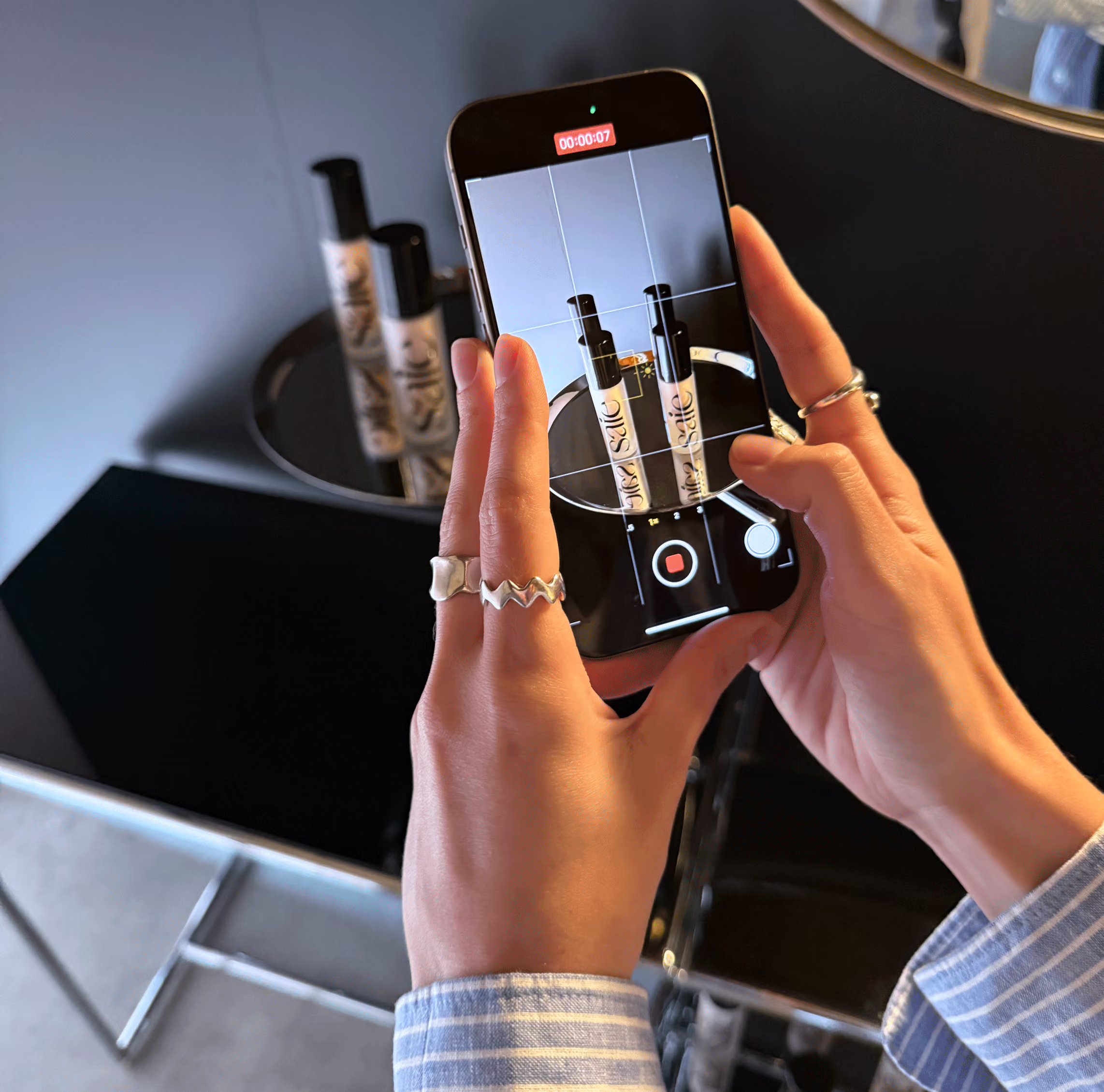

Short answer
Halloween 2026 is Saturday 31 October, but the shoot is a September job, not an October one. Nearly half of the US consumers NRF surveyed — 49% — began shopping in September or earlier, and NRF puts the most popular time to start decorating at the first half of October (45%).
What that evidence supports is a live window, not a date: 1–15 October. Backed out through a roughly three-week shoot-to-final turnaround, the two ends give you two shoot deadlines — 8 September for a 1 October launch, 22 September for a 15 October one. We recommend the earlier end and book 4 September, and you should know that the earlier end is also the one that sells us a shoot day sooner. Launch late in the window and more of your audience has already bought and decorated; launch early and you are paying to be in market longer. Pick your end of it deliberately.
Either way the shoot lands close to when our Black Friday calendar wants your Black Friday offer locked on 17 September — 13 days before it at the early end, 5 days after it at the late end. That collision, not the Halloween date, is the actual Q4 problem — and one half of it has six days of give in it that we will show you rather than hide.
Answer in one minute
QuestionAnswerBasisWhen must Halloween content be live?A window, not a date: 1–15 October 2026. We recommend the early endNRF/Prosper, 8,045 US consumers, fielded 2–9 September 2025, ±1.1pp supports the window. Which end you pick is a judgment call, and ours is the one that books a shoot soonerWhat about teasers before that?We are not recommending any. On this page's own three-week chain a 4 September shoot delivers around 25 September at the earliest, so we could not have made themUnbuildable, not merely unevidencedWhat is the last day to shoot it?8 September for a 1 October launch; 22 September for a 15 October one. We would book Friday 4 SeptemberOur own ~3-week shoot-to-final estimate — the weakest input on this page, unconfirmed, and not cleared for use outside our Black Friday calendarDoes that collide with Black Friday?Yes, twice — and the two are not equally binding. A 4 September shoot lands 13 days before the 17 September offer-lock, which is hard. The Halloween campaign then runs live over Black Friday's pre-production window, 1–15 October — but that one has about six days of give in itOur Black Friday calendarSo is 16 October the Black Friday deadline?Our Black Friday page calls 16 October the last safe shoot date — and the same page says that on the arithmetic alone you could shoot as late as about 22 October. Both sentences are ours and they are in tension; we are showing you the later one because it is the one that helps youOur Black Friday calendar, which states bothCan one shoot day serve both campaigns?Yes for offer-agnostic footage; no for in-camera offer copy. The price is deciding your Black Friday offer direction before 4 September. This is a deliberate carve-out from our own Black Friday rule, and we say so belowDream Aspect production methodShould every brand run Halloween content?No. If your category has no honest Halloween angle, the correct number of Halloween shoot days is zeroOur position — see "Where this cuts against us"What if we have missed the shoot window?UGC is the fastest remaining route. We are not printing a lead time and not deriving an order-by date from one — our own page publishes two windows that conflict. Ask for a committed delivery date in writingDream Aspect /ugc, retrieved 2026-08-25What does it cost?Social-media video packages start at $3,000 per shoot. UGC starts at $350 per video with a five-video minimum — so $1,750 is the real floor, not $350Dream Aspect published rates, retrieved 2026-08-25
How we evaluated the evidence
Two kinds of evidence sit underneath this article and only one of them is external, so it is worth separating them before you read a single date. The demand side — when people shop and decorate — is measured by a trade association on disclosed samples. The production side is entirely ours: self-reported, unconfirmed, and produced by a company that sells shoot days.
The demand side is external and reasonably good. When US consumers shop for Halloween, when they decorate, and when winter-holiday shopping starts are all measured by the National Retail Federation on disclosed samples of eight thousand-plus consumers with published fielding windows. That is where the timing evidence comes from — though the 1 October live date we derive from it is a judgment call, not a finding.
The production side is entirely ours. The shoot dates, the turnaround, the calendar — first-party, self-reported, and produced by the company that sells shoot days. No independent production benchmark exists for this, so we have not pretended to one. Read every date in the calendar as one Los Angeles studio's method, not an industry standard.
All external evidence here is observational — surveys of stated intent, platform guidance, and two large observational datasets of ad-account behaviour. Nothing here is experimental. Nobody has run a controlled test on when to shoot Halloween content, and if a source implies otherwise it is selling something.
Our three disqualifiers, since we invoke them below. We do not quote a statistic if (1) the publisher states no sample size, (2) the publisher states no date range or fielding window, or (3) the publisher's own disclaimer contradicts the reading the number is being used for. One source failed all three and was killed; it is named in the table.
What we used, and what we threw out
TierUsed hereExcluded, and whyTrade-association survey, disclosed sampleNRF/Prosper Halloween waves 2022, 2023, 2024, 2025; NRF winter-holiday 2025; NRF Valentine's back-seriesNothing — but note NRF is the retail industry's trade body and has a directional interest in large seasonal numbers, and its spending totals are projections from stated intentLarge observational ad datasets, disclosed methodologyMotion Creative Benchmarks 2026; Billo Q4 benchmarks—Vendor telemetry / forecastAdobe Analytics via Digital Commerce 360—Trade reportingDigiday, November 2022, on publisher-side Q4 deadlinesIts anecdote is a sample of one and is nearly four years old; used for the line, never as a statisticPlatform guidance (not research)Meta, Win over shoppers with ad formats they're engaging with and How winning hearts before peak season boosts carts; TikTok's learning-phase docs, Black Friday guide and holiday shopping guide. Titles are the publishers' own; where we use a shorthand we say soMeta's "2.1× higher purchase intent" claim — killed on disqualifiers 1 and 2. Its footnote reads "Meta Internal Analysis 2025" with no sample, no methodology and no date rangeCompetitor publicationLemonlight's marketer's calendar — quoted in full, including the clause usually dropped—Vendor blog / marketing contentSARAL, 99minds, Klaviyo, Toriut — quoted for what they say about timing, never as evidence. Each quotation re-checked against the publisher's own live page on 25 August 2026Their embedded statistics. SARAL repeats a $12.2bn NRF figure that is the 2023 wave; Klaviyo repeats a 2024 NRF per-person figure. Stale numbers laundered through a second publisher are still stale. Ad-intelligence archiveNothingA quotable "median Meta ad runs 4.0 days" figure from an ad-intelligence archive. Killed — it failed all three disqualifiers at once: no sample size, no date range, and a publisher disclaimer conceding the metric records when the ad was last observed rather than when the campaign ended, on a site selling subscriptions for which "your creative dies in four days" is precisely the pitch. We are not naming or quoting it, because we did not re-retrieve itSearch-result observationFour SERPs re-run 2026-08-21One result list that did not reproduce on re-run — reported as a pattern, not a ranking
Sources and their limits
SourceDatasetFindingLimitationNRF / Prosper Insights, 2025 Halloween survey8,045 US consumers, "conducted Sept. 2-9 and has a margin of error of plus or minus 1.1 percentage points"; pub. 2025-09-18"Nearly half of consumers (49%) began shopping in September or earlier, a slight increase from 47% the year prior." 73% plan to celebrate; per-person spending $114.45 — NRF's own word, not per celebrant; NRF projects $13.1bn total. Reasons for shopping early: looking forward to fall 44%, favourite holiday 37%, don't want to miss out 33%. Where they buy: discount stores 42%, specialty 31%, online 31%Self-reported recall, not transaction data. The denominator is US consumers surveyed, not celebrants — do not substitute. Fielded in the first nine days of September, so "September or earlier" is mostly August-and-before. This is the 2025 wave. The $13.1bn is a projection from stated intent; write "NRF projects," never "Americans spent." NRF is the retail trade associationNRF blog on the same 2025 surveySame 8,045-consumer sample; blog pub. 2025-10-01"The most popular time to start decorating is the first half of October (45%)." "Almost half of those who started browsing and buying more than a month in advance put out their decorations in September." "78% of Halloween shoppers expect to purchase décor, up from 72% in 2019"; décor spend $4.2bnThe blog restates no sample — the reader is asked to carry it from the press release. The blog does not publish the base for the 45%, so quote NRF's framing rather than inventing a denominator. The same 78% is benchmarked against two different years on two NRF pages: the blog says "up from 72% in 2019", the press release says "up from 75% last year". Neither is wrong; the blog picks the larger jump. Décor is a growth category retailers want promotedNRF Halloween hubLanding page for the annual wave; retrieved 2026-08-25"Results of the Halloween spending survey are released each year in late September." 2025 is still the latest wave as of 25 August 2026 — no 2026 figures exist yet. 2025 activity shares: handing out candy 66%, dressing up 51%, decorating the home or yard 51%The decorating-participation figure (51%) and the décor-purchase figure (78%) measure different things and must not be swappedNRF / Prosper, 2024 Halloween survey7,945 US consumers, fielded 3–8 Sept 2024, ±1.1pp; pub. 2024-09-19"47% of survey participants beginning their shopping before October", and separately "The figure is up from 37% five years ago and compares with just 32% in 2014."The 2019 and 2014 anchors are NRF restating its own back-series inside the 2024 release; the original 2014 release was not retrieved. This is a decade-scale level shift, not a recent trend — the year-to-year series is flat: 47 / 45 / 47 / 49NRF / Prosper, 2023 and 2022 Halloween waves2023: 8,084 consumers, 1–6 Sept 2023. 2022: 8,283 consumers, 1–6 Sept 2022. Both ±1.1pp2023: 45% plan to start before October, $12.2bn, $108.24 each, 73% participating. 2022: 47% beginning September or earlier, $10.6bn, ~$100 each, 69% celebratingThe denominator changes between waves, not only the wording. 2022 counts "Halloween enthusiasts"; 2023 counts "those celebrating the holiday"; 2024 and 2025 count all survey participants. Wording drifts too — 2023 and 2024 ask about "before October", 2022 and 2025 about "September or earlier". Do not stack the four into a series or an index. Only 2024 and 2025 share a baseNRF / Prosper, 2025 winter holiday survey8,247 US adults, fielded 1–7 Oct 2025, ±1.1pp; pub. 2025-10-16"42% of shoppers planning to begin browsing and buying for the holiday season before November." Spread out the budget 54%, avoid last-minute stress 41%; 60% expect to finish in DecemberStated intent. Note the fielding window is itself inside the collision this article describes — these people were answering during Halloween week oneNRF Valentine's Day hubRetrieved 2026-08-25Valentine's Day 2026 spending expected to reach a record $29.1 billion; the 2025 release recorded $27.5 billionUsed only to refute a ranking claim. The comparison crosses years — Valentine's 2026 against Halloween 2025 — and both are projections from stated intent, not receiptsMotion, Creative Benchmarks 2026 · tier table · portfolio · spend · methodology578,750 unique creatives, 6,015 advertiser accounts, $1.29bn realized Meta spend, 1 September 2025 – 1 January 2026. Accounts with ≥10 unique creatives only (MIN_ACCOUNT_CREATIVES = 10). Page last updated 2026-04-17Medium tier ($50K–$200K/mo): 6.6 creatives launched per week (mean, all verticals), 8.1% hit rate; top quartile of that tier 15.9/week. By vertical, the Medium cell is 8–12 for consumer categories — Fashion & Apparel 12, Health & Wellness 11, Beauty & Personal Care 8, stated as medians, so not the same statistic as the 6.6 mean. Portfolio shares Medium: 52.6% loser / 40.1% mid-range / 7.3% winner. Spend to winners rises Micro 23.0% → Enterprise 63.7%, Medium 53.3%The window is the season — 1 Sept to 1 Jan — so 6.6/week is a seasonal-period average, not a year-round baseline, and Motion states "Findings are specific to this window; patterns may look different in steady-state periods." Motion "does not tie outcomes to ROAS, revenue, or conversion." Motion sells an ad-insights platform, and its interest points toward volumeBillo, Q4 Meta video benchmarks80,069 sales-objective Meta video ads, July–December 2025, 14 industry verticals"Health & Beauty actually posts its highest Hook Rate of the entire year in December at 30.56%"Billo is a UGC production marketplace — it sells what we sell and shares our interest in "shoot more, earlier." Sample and window are disclosed, which is why we cite it. It cuts against the neatness of our own calendarBillo, How Many Ad Creatives Do You Need?Not a dataset. Billo's own words: benchmarks "draw from two major reports" — AppsFlyer's 2025 creative-optimization report and the Motion 2026 report already cited above. Page dated 22 June 2026Tier table: Starter $5K–$15K 3–5/wk · Growth $15K–$50K 8–15/wk · Scale $50K–$150K+ 20–30+/wk. Also: "During seasonal peaks like BFCM, plan for 2 to 3 times your normal cadence"Cited only to be declined. It is a synthesis, not a second measurement; its 20–30 figure is Admetrics' rate per $100,000 of monthly spend re-presented per account with no normalisation stated; and it reports Motion's mid-tier hit rate as 4% when Motion publishes 8.1% for Medium and 4.0% for Micro. Billo sells what Dream Aspect sells, and every one of these readings runs toward more productionAdobe Analytics, via Digital Commerce 360 · methodology at news.adobe.comAdobe Analytics: "over 1 trillion visits to U.S. retail sites, 100 million SKUs and 18 product categories"Amazon Prime Big Deal Days ran 7–8 October 2025, with Adobe forecasting $9 billion in US online spend across the two days. Season forecast $253.4bn, +5.3% YoYForecast, not measured sales. Adobe sells the analytics and experience software these retailers buy, so a longer and larger online season is directly good for Adobe's product story. Digital Commerce 360 is secondary reportingDigiday, "Halloween is when Christmas ends" by Kayleigh Barber (pub. 2022-11-24; re-read from the primary 2026-08-25)Trade reporting, sample of one for the anecdoteBryce Gruber, a senior shopping editor at Trusted Media Brands, quoted saying "for the most part, Halloween is when Christmas ends" Digiday's surrounding prose — "Aside from small updates or product additions to particularly well performing content" — is the reporter's, outside the quotation marks, and reporting on Reader's Digest, where gift-guide production begins in mid- to late August and is live by the first week of NovemberA trade story from November 2022 about publishers' editorial deadlines, not brands' shoot windows. Usable as a quotable line, never as a statistic.Lemonlight, Dates Every Marketer Needs to KnowCompetitor publication; retrieved 2026-08-25"Quality video takes weeks from concept to final cut, so a campaign you want live for a given holiday or sale should be in motion at least a quarter ahead." Halloween's entry: "Costumes and candy lead, but any brand can play with the spooky mood."Assertion of operating practice, no sample. §8d location check, taken from the contact page rather than from a city landing page: Lemonlight, Inc. publishes a street address — as published, "226 S Glasgow Ave, Inglewood, CA 90301" — which is Los Angeles County, not the City of Los Angeles. Its site also carries city landing pages: nine in the footer nav, 26 in its sitemap. None is an officeTikTok, Learning PhasePlatform documentation, "Last updated: June 2026""Typically, volatility starts to decline after about 25 campaign results or 7 days from when the campaign enters the learning phase."States no end date for the phase. The two conditions are joined by or, so whichever arrives first is the threshold. Seven days is neither the phase's length nor a floor on itDream Aspect published rates and delivery windowsHomepage, /ugc, /video-marketing; retrieved 2026-08-25Social-media video packages from $3,000 per shoot. UGC from $350 per video, "our minimum order is 5 videos per batch" → $1,750 floor. "Full content delivery typically takes 7-10 days after the content shoot day"Floors, not quotes. Our own /ugc page publishes two production windows that contradict each other — "The production timeline is 14 to 30 days" and "delivered as short as 7 days" — both live on 25 August 2026, and we have an internal ticket open to reconcile them. We therefore use no UGC lead time as a planning figure anywhere in this article. The two windows appear in this row and nowhere else, and they appear as the contradiction itself, not as a number to book againstDream Aspect edit-cycle estimateInternal; no sample, no published basis~3 weeks from shoot to finished campaign assetsAn internal estimate we have not confirmed — the weakest input on this page, inherited unchanged from our Black Friday calendar and deliberately not hardened. Every date in the calendar moves with it. Wrong in either direction, Dream Aspect benefits: longer and we gave you runway you did not have; shorter and we manufactured urgency. It is longer than our own published 7–10 day delivery window because first delivery is not a finished campaign — variants, paid cuts, captions and one approval round sit between them, and we have not published that scope difference anywhere on the site
Halloween content does not fail on 31 October. It fails in the second week of September, when a brand is still deciding whether Halloween is worth doing — and by the time that decision gets made, the only remaining answer is a pumpkin emoji on a stock photo.
Why is Halloween a production deadline and not a small campaign?
Because it is the earlier of your two Q4 deadlines, and it draws on the same crew, the same edit bay and the same fifteen days of your team's attention as Black Friday. A brand that treats Halloween as a garnish shoots it in October. October is when Black Friday pre-production has to close. You cannot spend the same fifteen days twice, and Halloween arrives first.
This is the reframe the whole article rests on. The question everyone asks — when do we start Black Friday content? — has an answer we publish in our Black Friday content calendar: twelve weeks out, with a shoot on 16 October. That twelve weeks is our own number and it sits at the long end of what other people publish. When we surveyed the Q4 advice pages in August 2026 the most-repeated figure was eight weeks, on content-marketing pages that cite each other and state no method — we are reporting the modal figure from that sweep, not a measured consensus, and we have not published the page list. What we checked and could not find is a creative production lead time from any industry survey, trade body or platform: the platform guidance cited below phases campaign and ad activity, not shoot dates. A longer lead time is the more agency-favourable one, which is why the shorter figure is printed here rather than left out. On an eight-week grid, Black Friday pre-production moves into late October and the second collision below shrinks. But that answer still assumes the September and October window is empty. For any brand that also does Halloween, it is not. The real question is what you shoot in September, given both.
And "given both" is not a hypothetical. NRF's 2025 winter-holiday survey of 8,247 US adults, fielded 1–7 October 2025, found 42% of shoppers planned to begin browsing and buying for the holiday season before November. Those are the same weeks. The two seasons are not sequential; they are concurrent — and they compete for one production window, not two.
There is a mechanism behind the overlap, and it is not consumer mood drifting earlier. It is a scheduled retail event. Amazon's Prime Big Deal Days ran 7–8 October 2025, with Adobe Analytics forecasting $9 billion in US online spend across those two days — a holiday-shopping trigger sitting squarely in the middle of what a brand would call its Halloween month. Adobe sells the analytics software these retailers buy, so read the number as vendor telemetry: credible on scale and direction, self-interested in framing.
The publishing side has known this for years, and says it more plainly than any marketing calendar does. Digiday reported in November 2022 that at Reader's Digest, gift-guide production begins in mid- to late August and is live by the first week of November — and quoted Bryce Gruber, then a senior shopping editor at Trusted Media Brands, saying that apart from small updates to content that is already performing, "for the most part, Halloween is when Christmas ends" That is one publisher, nearly four years ago, on editorial deadlines rather than shoot days. It is a good line and it is not a statistic.
When does Halloween content have to be live in 2026?
The evidence supports a live window of 1–15 October 2026. We recommend the early end of it, and the early end is also the end that books a shoot day sooner. Which parts are evidence and which are ours is worth separating carefully here, because this is the number every other date on the page is derived from.
The evidence comes from one NRF survey of 8,045 US consumers fielded 2–9 September 2025, ±1.1 percentage points.
First, "nearly half of consumers (49%) began shopping in September or earlier, a slight increase from 47% the year prior." That denominator is the US consumers NRF surveyed, not your customer base and not Halloween celebrants — 73% of the sample said they intended to celebrate at all.
Second, "the most popular time to start decorating is the first half of October (45%)" — and "almost half of those who started browsing and buying more than a month in advance put out their decorations in September." Decorating is the physical evidence of the season. It is the moment after the purchase.
Neither figure sets a single date. The shopping data argues for a September live date; the décor data points at the first half of October. Between them, what the evidence rules out is the second half of October — by then, on NRF's own numbers, a large share of the surveyed audience has both bought and decorated. That leaves a defensible window of 1–15 October, and the honest thing is to publish the whole of it rather than the end of it that suits us.
Here is what the two ends cost, using the same three-week turnaround throughout:
If your live date isHero assets finalShoot byWe would bookThu 1 October (early end)Tue 29 SeptemberTue 8 SeptemberFri 4 SeptemberThu 15 October (late end)Tue 13 OctoberTue 22 SeptemberFri 18 September
We recommend the early end, and we are the wrong people to take that recommendation from uncritically. A 1 October launch buys more days in market against an audience that is demonstrably already shopping; it also compresses your decision to ten days instead of twenty-four, and a compressed decision is how production companies get booked. The late end is genuinely defensible. If you take it, take it deliberately.
Be careful with the trend, because it is easy to oversell — and easier still to build out of incompatible parts. NRF's year-to-year numbers look flat: 47% in 2022, 45% in 2023, 47% in 2024, 49% in 2025. They are not a series. The 2022 wave counts "Halloween enthusiasts", the 2023 wave "those celebrating the holiday", and only the 2024 and 2025 waves are based on all survey participants. Two of the four points therefore rest on a smaller, more engaged denominator than the other two, and stacking them into one line claims more measurement than exists. What survives is narrower and still enough: on the two all-consumer waves, 47% and 49% of surveyed US consumers started before October — a level, not a slope. The genuine shift is decade-scale, and NRF states it in its own words: 47% before October in 2024, "The figure is up from 37% five years ago and compares with just 32% in 2014." Treat that back-series more cautiously than the rest. The 2019 and 2014 anchors are NRF restating its own older figures inside a later release, and we could not read the original. The candidate URL, nrf.com/media-center/press-releases/record-number-americans-buy-halloween-costumes, returned HTTP 404 on a direct request on 25 August 2026; an extraction proxy rendered that 404 page as roughly ten thousand characters of site navigation with no article text at all — zero occurrences of "2014", and the only "Halloween" on it inside the echoed URL. That is a 404 wearing a 200, and it should not be mistaken for the release. We therefore cannot confirm that the 2014 figure was measured on the same base as the 2024 one, and a denominator change across a decade would move the comparison in the direction that flatters the trend.
Note also where Halloween shoppers actually buy: discount stores 42%, specialty Halloween and costume stores 31%, online 31%. Online is tied for second, not first. Halloween content is doing work in retail media, in-store and social — not only on your own product detail pages.
Everyone else who publishes a date lands in the same window, which is reassuring and also a little suspicious given they mostly sell software that gets used on that date. SARAL: "Launch main campaign content between October 1–15 for maximum organic reach." 99minds: "Start planning in late August and launch promotions by early October to capture early shoppers." Meta's Win over shoppers with ad formats they're engaging with, dated 12 August 2026 — "seasonal calendar" is our label for it, not Meta's — heads its first phase "The discovery phase (October into early November)".
Our contribution is the step none of them take: an October 1 publish date is a September shoot date.
What is the last day to shoot Halloween content for 2026?
8 September for a 1 October launch, 22 September for a 15 October one. We would book Friday 4 September, which is ten days from 25 August. The gap between the arithmetic date and the booking date is a buffer we chose, not a fact about Halloween.
The working for the early end, so you can disagree with it precisely rather than vaguely:
- Main campaign live 1 October
- Hero assets final and scheduled 29 September — two days, which is thin
- Minus a roughly three-week shoot-to-final turnaround → shoot by 8 September
- Book at 4 September so that talent, samples and locations can slip four days without breaking anything
That three-week figure is doing a great deal of work, and it deserves the same flag it carries in our Black Friday calendar: it is our own edit-cycle estimate, not an industry standard, with no sample and no published basis behind it. It is deliberately longer than the 7–10 days our own video marketing page quotes for delivery after a shoot day, because first delivery is not a finished campaign — variants, paid cuts, captions and one client approval round sit in between. And it is wrong in a way that suits us either way: if the true turnaround is longer, we have handed you runway you do not have; if it is shorter, we have manufactured urgency. That is exactly why it is printed here rather than quietly used. A studio with a faster post pipeline can honestly set a later date, and if yours does, move ours.
One difference from the Black Friday calendar is worth naming. That calendar leaves about six days between its arithmetic-only last shoot date (22 October) and the date it recommends booking (16 October). Halloween here gets four. That is not evidence that Halloween is less forgiving — it is us choosing a smaller buffer on a shorter runway. The buffer is a decision variable the seller sets. If you want the same six days of cover, shoot 2 September instead.
What does the Halloween + Black Friday calendar actually look like?
Both campaigns, on one calendar, from 25 August to Cyber Monday. The Halloween dates are derived here; the Black Friday dates are inherited unchanged from our Black Friday calendar — including its 22 October arithmetic-only limit.
Every plotted value and every bar boundary, as text.
The 2026 Q4 production calendar for Halloween and Black Friday. Halloween milestones derived by Dream Aspect from NRF/Prosper 2025 timing data (8,045 US consumers, fielded 2–9 September 2025) and our own unconfirmed ~3-week shoot-to-final estimate; Black Friday milestones inherited unchanged from the Dream Aspect Black Friday content calendar. Compiled 25 August 2026.
MilestoneDate (2026)DayWeeks from 25 AugCampaignCalendar anchor · Halloween pre-production opensTue 25 AugTue0.0HalloweenDecide whether you are doing Halloween at allFri 28 AugFri0.4HalloweenCreative direction and shot list lockedWed 2 SepWed1.1HalloweenHalloween shoot (booked) · Black Friday concept and pre-production opensFri 4 SepFri1.4bothHalloween shoot — arithmetic-only last dateTue 8 SepTue2.0HalloweenBlack Friday offer lockedThu 17 SepThu3.3Black FridayHalloween hero assets finalTue 29 SepTue5.0HalloweenHalloween campaign live — contested window opensThu 1 OctThu5.3HalloweenBlack Friday pre-production locked — contested window closesThu 15 OctThu7.3Black FridayBlack Friday shoot, as we plan itFri 16 OctFri7.4Black FridayBlack Friday shoot — arithmetic-only last dateThu 22 OctThu8.3Black FridayHalloweenSat 31 OctSat9.6HalloweenBlack Friday hero assets finalThu 12 NovThu11.3Black FridayBlack Friday warm-up liveFri 13 NovFri11.4Black FridayEverything scheduled, nothing left to makeWed 25 NovWed13.1Black FridayBlack FridayFri 27 NovFri13.4—Cyber MondayMon 30 NovMon13.9—
Why does the Halloween shoot collide with your Black Friday calendar?
Twice, in two different ways — and only one of them is genuinely binding.
Collision one, in September. This is the binding one. The Halloween shoot is 4 September. Our Black Friday calendar locks the offer on 17 September. The shoot happens thirteen days before the offer exists. If you want one shoot to serve both, you have to bring the offer decision — or at least its direction — forward of 4 September. That is ten days from 25 August. It is the uncomfortable ask in this article and there is no way to soften it, because the alternative is a second shoot day.
Collision two, in October. Real, and partly relievable. Our Black Friday pre-production runs 1–15 October: shot lists, schedules, talent confirmed, everything closed before the 16 October shoot. Every reference to the contested window on this page is 1–15 October, the days on which a live Halloween campaign and a closing Black Friday pre-production overlap. That window is the first half of your live Halloween campaign — the window NRF puts as the most popular time to start decorating, the window your paid team is optimising and your community manager is replying to comments.
And our own Black Friday page contradicts itself here, in a way that is useful to you. It calls 16 October "the last safe shoot date" — in its summary table, its heading and its answer — and then, further down the same page, says: on the arithmetic alone you could shoot as late as about 22 October; we do not plan to that date because talent, samples and locations slip, and past it the approval round is what gets eaten. Both sentences are ours. The later one is the one that helps you, so it is the one we are putting in front of you.
What those six days actually buy is narrower than it sounds, and we are not going to round it up. They are slack on the shoot date, not on pre-production. A brand that runs pre-production through to 22 October has pushed the shoot to 22 October too — onto the arithmetic limit itself, with the entire slip allowance spent and nothing left for a sick talent or a late sample. The realistic version is a few days, not six: close pre-production around 19–20 October, shoot on the 20th or 21st, and accept that you are past the date we would plan to. That is still relief, it is still worth knowing before you book a second shoot day from us, and it is smaller than a page that wanted to sell you one would admit.
So the brand that shoots Halloween in October gets the worse version of both. Content live in the second half of October, into an audience that on NRF's numbers has substantially bought and decorated. And Black Friday pre-production run by people who are mid-campaign, with the six days of slack already spent on being late.
Here is what makes this hard to see: very little on the advice surface connects the two. TikTok's Black Friday guide answers "When should I launch my Black Friday campaign on TikTok?" with "Start preparing in September, finalize creative and partnerships in October, and go live in early November to capture early and peak shoppers" — and never mentions Halloween. TikTok's holiday shopping ads guide heads its first phase "Pre-holiday (October to early November): Build awareness and anticipation" and never mentions Halloween. Meta's Win over shoppers with ad formats they're engaging with, dated August 12, 2026, opens its discovery phase "(October into early November)" and never mentions Halloween. Meta's 2026 quarterly planning cadence, dated June 11, 2026, runs "Identify aligned creator partners" in Q2, "Begin creator content and partnership ads." in Q3 and "Full integrated strategy at peak investment." in Q4 — and never mentions Halloween either. That last page is phasing ad investment rather than a seasonal calendar, so its silence is weaker evidence than the other three; we count it because it is the document a brand is told to plan Q4 against. Toriut's retail calendar gets closest of any of them. It opens October with "October has two faces: Halloween and early holiday planning", heads the section "Halloween and holiday teasers" and says "October is your last full month for finalizing holiday catalog changes". It names the duality. What it does not do is say the two jobs compete for the same production capacity — which is the whole argument here.
Klaviyo goes further, and on our reading it points the wrong way: "Halloween is a great testing ground for the most lucrative shopping event of the year: Black Friday Cyber Monday (BFCM)." That is true only if the Halloween creative and the Black Friday creative came out of the same production run. If Halloween is a separate project shot in October, it is not a testing ground for Black Friday — it is a competitor for Black Friday's window, and it consumes the window in which Black Friday's test creative would have been made.
The search results say the same thing from the other direction, with one qualification we owe you. We re-ran when to start Halloween social content on 21 August 2026 and it reproduced exactly: ten result slots held by nine distinct publishers — Brandwatch, Strike Social (twice), Inflact, Cloud Campaign, Hootsuite, Walls.io, Starling Social, getkoro.app and bu.edu. Checking each against its own description on 25 August 2026: six sell listening, scheduling or paid social. Three do not — Walls.io sells a social wall for events and displays, getkoro.app is an AI ad-maker producing UGC and product video, and bu.edu is a university.
What is true of all nine, and is the only part carrying any weight: every one answers a posting date, and not one takes the step to a shoot date. getkoro.app is the sharpest version of it — a tool that exists to make the content still tells you when to post it, not when to shoot it. A separate query on Halloween DTC calendars returned 99minds, scalegrowth.digital, directtoconsumer.co, getsaral.com, printkk.com and shopify.com/enterprise — six ecommerce and promotions vendors, zero production studios. SERPs are personalised and shift; a fourth query we ran did not reproduce its ranking on re-run, and we are reporting the pattern rather than the list.
Even our competitors stop short. Lemonlight — a video production company whose contact page publishes an address at "226 S Glasgow Ave, Inglewood, CA 90301", which is Los Angeles County rather than the City of Los Angeles — has the same commercial incentive we do, and its marketer's calendar lists Halloween and Black Friday as separate Q4 entries with a single lead-time rule: "Quality video takes weeks from concept to final cut, so a campaign you want live for a given holiday or sale should be in motion at least a quarter ahead." Halloween's entry reads "Costumes and candy lead, but any brand can play with the spooky mood." No shoot date for either. No suggestion the two might share one. That is an assertion of operating practice with no sample behind it — and, in four searches, it is the closest thing to this article that we found.
Can one shoot day serve both Halloween and Black Friday?
Yes — but only for the footage that does not depend on the offer, and only if you accept that Black Friday's offer copy goes on in post rather than in camera. That is the trade. It is a real one, and a studio that tells you there is no trade is selling you a shoot day.
And it is a deliberate carve-out from our own rule. Our Black Friday calendar states, without qualification, that you cannot film against an offer nobody has decided. That rule is right about anything with the offer in it — the percentage on screen, the countdown, the scripted claim. It does not bind neutral footage, and we are saying so here rather than quietly contradicting ourselves on two pages of the same site.
A shoot day does not divide into campaigns. It divides into set-ups — a lighting state, a set dressing, a wardrobe, a shot list. On a single September day in Los Angeles, that looks like:
Morning block, Halloween-dressed. Seasonal set dressing, seasonal wardrobe, the mood that carries the 44% of NRF's early shoppers who give "looking forward to fall" as their reason — the base is consumers already shopping early, not the whole sample. Treat those stated motivations as colour for creative direction, not as causal evidence — self-reported reasons are post-rationalised by design.
Afternoon block, undressed. Same crew, same talent day rate, same location, neutral set. Clean product hero, packaging, texture, lifestyle. This is Black Friday's base layer and it has no season in it.
In post. The offer graphic, the percentage, the countdown, the Cyber Monday variant. Added after your 17 September offer lock, cut from footage that already exists.
What cannot cross over is short and worth stating plainly: anything with the offer in camera, and anything visibly Halloween used after 1 November. A jack-o'-lantern in the corner of a Black Friday ad is not a saving. It is a mistake you paid to make.
This is the part a project-by-project model cannot do, and the reason is structural rather than a matter of skill. A project model scopes and quotes Halloween in August as a Halloween project, then scopes and quotes Black Friday in October as a Black Friday project. Two scopes, two pre-productions, two crew days, two edit cycles — and the second one lands in the window the first one is live. A recurring model already has a September shoot day on the calendar; the only question is what goes on the truck. On one recurring engagement we produce 15 videos a month for a single brand. That figure comes from our own delivery records and appears on no page of this site, so there is nothing to link it to and we are not going to imply otherwise — it is one engagement's volume, not a published standard and not a capacity ceiling.
We should be straight about the incentive here: the version of this article that makes us more money recommends two shoots. We are recommending one, because the second one would happen during the first one's launch week, which is the worst possible time to run it.
How much creative does the October window actually consume?
About as much as any other month of the season — which is the point. You cannot manufacture creative volume inside October; you can only cut it from footage that already exists. If October has to carry a Halloween campaign and Black Friday's warm-up testing, that footage was shot in September or it does not exist. Whether the season needs a step up in volume is contested.
Motion's Creative Benchmarks 2026 is the one dataset here with a large, disclosed, real-spend sample and a published methodology: 578,750 unique creatives across 6,015 accounts and $1.29 billion of realized Meta spend, from 1 September 2025 to 1 January 2026, restricted to accounts running at least ten unique creatives. That window is literally the window this article is about — which is both why it is the right dataset and why its numbers are seasonal-period averages rather than year-round baselines. Motion says so: "Findings are specific to this window; patterns may look different in steady-state periods."
Read the tier column carefully. Motion's tiers are monthly Meta ad spend alone, not total marketing budget. The brand this article is written for — spending from roughly $500,000 a year across all marketing — is very unlikely to be putting $50,000–200,000 a month into Meta. On the tier definitions they are Small, or Micro.
Account tier (monthly Meta spend)New creatives launched per weekHit rateWinner share of all creativesMicro (<$10K)2.84.0%3.7%Small ($10K–$50K)4.16.4%6.2%Medium ($50K–$200K)6.68.1%7.3%Large ($200K–$1M)11.28.6%8.1%Enterprise ($1M+)18.88.8%8.2%
Motion Creative Benchmarks 2026; 578,750 creatives, 6,015 accounts, $1.29bn realized Meta spend, 1 Sept 2025 – 1 Jan 2026. Page last updated 2026-04-17.
The last two columns are two different measures and it matters. Motion defines hit rate as (winner creatives ÷ total creatives) × 100 computed per account and then averaged unweighted across accounts in the tier — every account counts equally regardless of size. The winner share column is the share of all creatives in the tier that were winners. Same underlying event, different arithmetic, and they do not agree: 4.0% against 3.7% at Micro, 8.8% against 8.2% at Enterprise. A winner is a creative that spent at least 10× its account's median creative spend and at least $500 in absolute terms. Across the whole dataset roughly 5% of creatives clear that bar. Spend then concentrates hard behind them: 53.3% of Medium-tier spend goes to winners, rising from 23.0% at Micro to 63.7% at Enterprise.
Motion's top quartile of Medium-tier accounts by winner count — selected on winners, not on volume — ship 15.9 creatives a week against their tier average of 6.6, a 2.4× gap inside a single tier.
Which row is yours
We have printed the smallest surviving number rather than the largest. On the tier definitions, the brand this article is written for is Small, or possibly Micro, not Medium, so the all-vertical base rate is 4.1 or 2.8 a week, not 6.6 — which runs against us and shrinks October to roughly 12 to 18 creatives.
This one runs toward us, which is why it needs saying out loud. The tier figures above are means across every vertical. Motion also publishes the same measure cut by industry, and from the Medium tier upward the consumer categories this article is written for sit above the all-vertical average — though not at every tier: at Small, two of the three consumer rows sit slightly below it. Motion's published sample:
VerticalMicro (<$10K)Small ($10K–$50K)Medium ($50K–$200K)LargeEnterpriseFashion & Apparel35121833Health & Wellness34111946Beauty & Personal Care3481526"Other" (verticals under 50 accounts)2381414All-vertical tier figure, for comparison2.84.16.611.218.8
Motion Creative Benchmarks 2026, testing by vertical. Read Motion's own caveats before using these cells. Motion calls the table an "illustrative sample drawn from the full vertical-by-tier heatmap", says exact cell values vary, describes the values as "median creatives launched per week per account", and states that "exact cell values [were] not fully reconstructed here from PDF OCR". Verticals with fewer than 50 accounts are suppressed into "Other". The all-vertical row is a mean, so it is not strictly the same statistic as the cells above it and the two should not be differenced. On our own third disqualifier — a publisher's disclaimer contradicting the reading — this table is an order of magnitude, not a benchmark, and we are using it as one.
So a consumer brand at Medium spend sits at 8–12 a week where the all-vertical mean says 6.6 — and Motion agrees this is how to read it: "If your vertical's Medium average is materially higher (like Fashion's ~12), that's the benchmark you should be comparing to — not the all-vertical average."
But the row that matches the brand this article is written for is the Small one, and it carries the smallest number on this page: 4 to 5 creatives a week, or roughly 18 to 22 across October.
So the honest span is about 18 to 53 creatives in October, depending on tier and vertical, and the brand this article is written for sits at the bottom of it. We would rather print a wide true range than a narrow flattering number. Motion's own framing is the honest one: "There is no universal best testing volume." If the underlying question is how much a brand should be making in a normal month rather than in October, we work through that evidence separately in how many videos a month a brand needs.
Our arithmetic, flagged as ours. October 2026 is 31 days, about 4.4 weeks. On the consumer-vertical Small cells that match the brand this article is written for — 4 to 5 creatives a week — that is roughly 18 to 22. On the all-vertical Medium rate of 6.6 it is about 29; on the consumer-vertical Medium rows, 35 to 53. Every one of those multiplications is ours, not a Motion finding, and each assumes a flat weekly rate across the month that Motion did not test for within-season variation. And none of them is a figure on top of your normal output — each is roughly your normal output for this season, which is the real point. October does not need more creative than usual; it needs the usual amount to have already been shot, at a moment when the shoot day is competing with a live campaign. If these numbers are too high, we benefit — a bigger creative requirement makes a production studio more necessary — so treat them as an order of magnitude, not a target.
The reason a library does not rescue you sits in Motion's own definitions. A loser is a creative "turned off (or never reached active spend) before 28 days", and losers are 49.3–53.9% of creatives across the spend tiers — 52.6% at Medium. On who does the turning off, we defer to Motion rather than to our own reading: "Losers are ads that the auction turned off before they accumulated meaningful spend", and "That ratio isn't a function of advertiser strategy or budget; it's a property of the auction." Motion says it is not the advertiser's decision. Either way the operational fact is the same — you are not building a library that keeps working through October.
One source carries all of this, and you should know that before you act on it. Every creative-volume number in this section — the 6.6, the 8–12, the 29, the loser share — descends from Motion's dataset. The one competing tier table we found, Billo's, turns out to be a synthesis of Motion's own report plus two others rather than an independent measurement of the same quantity. So there is no second measurement here, only a second reading of this one. Read the section as what Motion measured, not as an established rate.
Motion is explicit that its report "does not tie outcomes to ROAS, revenue, or conversion" — it measures where Meta's auction allocated budget, not what made money. Never read the 5% winner rate as a profitability figure. And note the obvious conflict: Motion sells an ad-insights platform, and "volume is the dominant lever" — Motion's own phrase — is exactly what its product services. We are citing it because the sample is unusually large, the methodology is published, and the report states its own limits, which is more than any other creative-volume source in this set managed. Motion's own summary of the tier pattern is "volume is the dominant lever behind winner production at scale" — the pro-production reading, and we are not going to dress it up as a caveat. The genuine qualifier beside it is narrower: the per-creative hit rate improves only modestly with scale, "roughly doubl[ing] from Micro (4.0%) to Enterprise (8.8%)", against a 6.7× jump in volume. More shots, not better ones.
Two platform constraints stack on top. Meta's own guidance is that "Adding 3 or more creative formats can make the difference" — can, on a marketing page under a "Diversify your creative" call to action, with no sample behind it. It is advice from the seller of the inventory, not a requirement and not a measured result. And TikTok's documentation says volatility "starts to decline after about 25 campaign results or 7 days from when the campaign enters the learning phase" (the page reads "Last updated: June 2026"). It gives no end date for the phase, and the two conditions are joined by or, so whichever arrives first is the threshold — seven days is neither the phase's length nor a floor on it. TikTok describes when volatility begins to decline; it does not say the phase ends, and we should not write a verb it does not use. For a creative launched in the last week of October, the seven-day arm puts the start of that decline before Halloween and the 25-results arm may not — which arm binds depends on result volume we have not measured. Treat this as a risk to check, not a finding.
What if you have already missed the shoot window?
If you have not shot, there are three routes and they narrow fast: order UGC now and get a delivery date in writing, recut what you already own, or skip Halloween and put September into Black Friday. We are deliberately not printing an order-by date for the first of those, and the reason is worth a sentence.
Route one: UGC, and we will not tell you the deadline. UGC is the one genuinely fast route left, and it needs no crew, no location and no shoot day. On average, pricing starts at $350 per video, with a five-video minimum — so the real floor is $1,750, not $350. We are not printing a lead-time window and we are not deriving an order-by date from one. Our own /ugc page currently publishes two production windows that contradict each other and we have an open ticket to fix it. Ask for a committed delivery date in writing, and check it against whichever live date you have picked — 1 or 15 October — before you order.
Route two: recut what exists. If the shoot window has closed and nothing is booked, a launched Halloween campaign is largely gone, but recutting is not. Most brands own more usable footage than they remember, and the formats that need no shoot day are a longer list than it looks. Do not try to fake a shoot with stock. A borrowed autumn is visible.
Route three: skip it on purpose. Past 22 September — the late end of the shoot window — stop. Put September into Black Friday, where the twelve-week grid still works and 16 October is still a planned shoot date with six days behind it. Skipping Halloween deliberately costs you a season. Half-shipping it in late October costs you the season and most of Black Friday's slip buffer.
One caveat on all of that. If the honest scope is a single September day and a dozen assets, a retainer is the wrong instrument and we are the wrong call. Find a freelance crew, shoot it, ship it. The standing-capacity question is a January conversation, and it goes better when nothing is on fire.
Where this cuts against us
The strongest case against this article is that we sell shoot days and every date on it is one of ours. Each of the things that follow is stated with the direction it moves.
Halloween is not the second-largest single-day consumer spending occasion NRF tracks. NRF's Valentine's Day hub puts Valentine's Day at a record $29.1 billion for 2026 and $27.5 billion for 2025, against Halloween's $13.1 billion — more than double either way, and note the comparison crosses years. Do not rank Halloween second by any measure. And the $13.1bn itself is an NRF projection extrapolated from stated purchase intent, not measured receipts: write "NRF projects," never "Americans spent."
No source said when most brands post their first Halloween asset. What the evidence actually supports and no more: by the second half of October, on NRF's numbers, a large share of the surveyed audience has bought and decorated. We do not know when most brands post.
Six days make one collision partly survivable. Our Black Friday calendar publishes an arithmetic-only last shoot date of 22 October, six days past the 16 October we plan to. A binding collision sells a September booking, and this one is partly relievable. Two honest qualifications: that page also calls 16 October "the last safe shoot date" in three places, so the two dates sit in tension on our own site and we have not resolved it; and the six days are slack on the shoot, not extra room for pre-production, so the usable relief is nearer three or four days than six.
Not every brand should do Halloween, and we make less money saying so. NRF's décor and participation data describes people buying costumes, candy and decorations. If you sell mattresses, accounting software or medical devices, the correct number of Halloween shoot days is zero, and a studio that tells you otherwise is selling you a shoot day rather than a campaign. Forcing a spooky angle costs you the September window and buys a costume.
Category seasonality is not uniform, and October is not everyone's peak. Billo's analysis of 80,069 sales-objective Meta video ads running July–December 2025 across 14 verticals found Health & Beauty posts its highest hook rate in December, at 30.56% — nowhere near October. Billo writes "of the entire year"; its window is July–December 2025, so it cannot establish an annual maximum and we should not repeat that phrase as though it can. Billo is a UGC production marketplace, which means it sells the same thing we do and has the same interest in "shoot more, earlier." We cite it because its sample and window are disclosed and because it cuts against the neatness of our own calendar — and we are applying the same scope caveat we apply to sources that flatter us.
The load-bearing production number is ours, it is soft, and it is wrong in our favour either way. The roughly three-week shoot-to-final turnaround has no sample and no published basis. It is inherited unchanged from our Black Friday calendar, where it is already flagged as the weakest input on that page, and we have not quietly hardened it here to make the collision look sharper. Every date in the calendar moves with it. If it is too long we gave you runway you did not have; if it is too short we manufactured urgency. Both errors sell shoot days. A studio with a faster post pipeline can honestly publish a later shoot date, and if your current partner does, use theirs.
Half our demand data will be superseded within about a month. Every current NRF Halloween figure here is the 2025 wave; the 2022–2024 figures are historical and will not be superseded. NRF states that the survey is released "each year in late September"; the last two waves published on 18 September 2025 and 19 September 2024 — roughly 3–4 weeks after this article. If you are reading this in October, re-check the timing figures before quoting them.
And the whole page is a sales argument. We sell recurring production. An article whose conclusion is "recurring capacity solves the Q4 collision" is not a neutral finding — it is our commercial position, arrived at from data we chose. The parts you should trust least are the ones where we are the only source: the turnaround, the shoot dates, the set-up split. The parts you can check are all linked.
Who can still shoot Halloween content in Los Angeles this September?
Read on 25 August 2026, this article resolves to one booking window and one question. The window runs to 4 September for a 1 October launch, or to 18 September if you take the later end — ten days or twenty-four. The question is what direction your Black Friday offer is likely to take, because that is the only thing standing between one shoot day and two.
Every date on this page is priced in Los Angeles crew, talent and location bookings, and we are not travelling to shoots at present — so a brand shooting in Chicago or London should take the argument and rebuild the window around its own market. The calendar is ours. The reasoning transfers.
The brands that handle this well do not have the best Q4 plan. They have a September shoot day that was already on the calendar, so the collision never arrives as a crisis — it arrives as a packing list. Our twelve months with one wellness brand is the nearest thing to a worked example we can publish. And if the answer for your product is CGI — no location, no talent, no weather, no September — the whole calendar on this page changes shape and is a separate conversation.
Key takeaways
- Halloween 2026 is Saturday 31 October, but the shoot is a September job, not an October one.
- The evidence supports a live window, not a date: 1–15 October 2026.
- Backed out through a roughly three-week shoot-to-final turnaround, that is a shoot by 8 September for a 1 October launch, or 22 September for a 15 October one.
- We recommend the early end and would book Friday 4 September, 13 days before the 17 September Black Friday offer lock.
- Nearly half of the US consumers NRF surveyed — 49% — began shopping in September or earlier.
Frequently asked questions
When should we shoot Halloween content for 2026?
Friday 4 September 2026 if you launch on 1 October, or Friday 18 September if you launch on 15 October — the two ends of the window NRF's timing data supports. The arithmetic-only last dates are 8 and 22 September. All four rest on a three-week turnaround that is our own unconfirmed estimate, so treat them as our numbers rather than an industry standard.
Is 31 October the date I should be planning against?
No. Halloween 2026 is Saturday 31 October, but the purchase and the décor install both happen earlier — NRF's 2025 survey of 8,045 US consumers puts the most popular decorating window at the first half of October. Plan against 1 October as your live date and treat 31 October as the day the campaign ends, not the day it peaks.
Does this contradict your Black Friday calendar?
No, and one correction matters. Its 16 October shoot is the date we plan to, not the last one available — on the arithmetic you can shoot as late as about 22 October. A brand running Halloween as well can use those six days to slide Black Friday pre-production past the contested first half of October. It costs the entire slip buffer, so it is relief rather than a free pass.
Can one shoot day really cover Halloween and Black Friday?
For the footage that does not depend on the offer, yes — product hero, packaging, texture, lifestyle, talent. Split the day into set-ups rather than campaigns: seasonal dressing in one block, neutral in another. The offer graphic goes on in post, after your 17 September lock. This is a deliberate carve-out from our own rule that you cannot film against an undecided offer; that rule still binds anything with the offer in camera.
How much content does the October window need?
Roughly what the season needs anyway. Motion's benchmark of 578,750 creatives and $1.29bn of Meta spend, 1 September 2025 to 1 January 2026 puts a brand at this article's spend level at 4 to 5 new creatives a week — about 18 to 22 across October. Multiplying is our arithmetic, not Motion's, and it describes normal seasonal output rather than an increment. Half of all creatives are switched off inside 28 days, so a library will not carry the month.
We have not shot anything. What is the fastest option?
UGC video — from $350 per video with a five-video minimum, so $1,750 is the floor. We are not quoting a turnaround here, because our own page publishes two that conflict and we have an open ticket to fix it. Ask for a committed delivery date in writing and check it clears your own live date with room. Past 22 September, skip Halloween and put what is left of the month into Black Friday.
Should we just skip Halloween and do Black Friday properly?
For many brands, yes, and it is the better of the two bad options. Skipping deliberately costs you one season. Half-shipping Halloween in October costs you the season and most of Black Friday's slip buffer. If your category has no honest Halloween angle at all — most B2B, most considered-purchase categories — the decision is easy.
Why does nobody else give a Halloween shoot date?
Because the people publishing Halloween timing advice mostly sell scheduling, listening or promotion software, so their answer is a posting date — posting is what their product does. On the search we re-ran on 21 August 2026, six of the nine distinct publishers sold listening, scheduling or paid social; the other three were a social-wall product, an AI ad-maker and a university. All nine answered a posting date. None took the step to a shoot date.
- https://dreamaspect.co/ugc
- https://dreamaspect.co
- https://dreamaspect.co/case-study/from-decline-to-scale-how-we-grew-balas-views-4-5x-to-15m
- https://dreamaspect.co/cgi
- https://dreamaspect.co/contact-us
- https://dreamaspect.co/video-marketing
- https://nrf.com/media-center/press-releases/nrf-consumer-survey-finds-halloween-spending-to-reach-record-13-1-billion
- https://nrf.com/blog/halloween-shoppers-are-prioritizing-decor-and-spending-more