


Short answer
B2B and B2C product video are made for different buyers. B2B research describes buying groups that average 10+ members (6sense, 2023–2024) over an average 10.1-month cycle (2025). Consumer research we found measures output: Meta advertisers spending up to $200K a month launched 2.8–6.6 new creatives a week on average (Motion). Our reading, as Dream Aspect, a Los Angeles video production company: plan B2B for a committee, B2C for replacement.
Answer in one minute
- Who decides: B2B, a group — 6sense's 2023–2024 studies found groups that "average 10+ members"; Forrester puts the typical decision at 13 internal stakeholders and nine external influencers. B2C, usually one shopper, on our reading; we found no primary measure. Basis: 6sense; Forrester, 21 January 2026.
- How long it takes: B2B, an average of 10.1 months in 2025, down from 11.3 in 2024. B2C, no comparable primary found. Basis: 6sense, nearly 4,000 B2B buyers.
- Length: only the B2B side was found. LinkedIn recommends video ads of 15–30 seconds so they can qualify for every placement across its Feed and Audience Network, in-stream included; no consumer-platform recommendation was found. Basis: LinkedIn Help; Meta's Reels ads page.
- The long asset: Stripe's 11 min 53 s Sessions 2026 cut is 13% of the 91 min 29 s keynote it links to. Basis: YouTube; our arithmetic.
- Proof: B2B, familiarity — 2025 buyers had prior experience with an average of 3.8 of the 5 vendors on their shortlist. B2C, a real user — an endorser shown using a product must be a "bona fide user". Basis: 6sense; 16 CFR 255.1(c).
- Cadence: B2C is measured as ads launched — 2.8, 4.1 and 6.6 a week on average at under $10K, $10K–$50K and $50K–$200K a month on Meta, September 2025 to January 2026. B2B is measured as buyer contact — an average of 16 interactions with the winning vendor. Basis: Motion; 6sense.
- Who is on camera: B2B, in Stripe's keynote, its CEO and its President of Product and Business. B2C, where a person is used, Meta promotes creators; Motion's top-ranked asset types are text and product images. Basis: their own pages.
- What to make: our reading, not a measured result — for a committee, one anchor asset cut many ways; for shoppers, batches you can replace.
- The point against us: Dream Aspect has published no software or B2B case study, and its CGI page is titled for consumer brands. Basis: our sitemap and CGI page, 6 October 2026.
How we evaluated the evidence
We held eight criteria constant and filled each for both buyers from a published source read on 6 October 2026. Where one side had no primary source, we say so. Length and cadence are measured differently on each side, and the lists say what each value measures.
The two cities are illustrations, not datasets. 6sense surveys buyers in North America, APAC and EMEA, Forrester publishes no sample in its release, and Motion measures Meta advertisers; none of the three is city-specific. The San Francisco examples are two companies tied to the city on their own pages. We have no Los Angeles-specific data.
None of the evidence is experimental. No study we read measures which kind of video wins a B2B purchase. Every "make this" sentence below is our inference, labelled as ours.
Sources and their limits
- 6sense, 2025 Buyer Experience Report — "nearly 4,000 responses", "a minimum spend of $25,000" to qualify, technology (42%) and services (38%) firms; also summarises its 2023 and 2024 studies. Limit: 6sense sells "The ABM Platform Powered by Revenue Intelligence" (its homepage title); read through a text-extraction service, because the page did not answer us directly.
- Forrester, The State Of Business Buying, 2026 — release of 21 January 2026. Limit: Forrester describes itself as a "research and advisory" firm; no sample size or field dates in the release; we did not read the report.
- LinkedIn, 95-5 Rule — LinkedIn's own research; the computers and cars figures are from its joint research with the Ehrenberg-Bass Institute. Also LinkedIn Help, video ads. Limit: LinkedIn sells the ads both pages discuss (the 95-5 page carries a "Create ad" button); no method or sample stated; the length advice sits under its in-stream best-practice heading.
- Motion, Creative Benchmarks 2026 — 6,015 accounts, 578,750 creatives, $1.29 billion of Meta spend, 1 September 2025 to 1 January 2026. Limit: Motion sells "AI-powered creative analytics" (its homepage, which carries pricing and a free trial); Meta only; a holiday window that "may look different in steady-state periods"; its vertical table is "an illustrative sample" of "Median (or mean)" values.
- Stripe and Figma — Stripe Sessions 2026, its release datelined "SAN FRANCISCO", its customer index, a keynote and its cut; Figma's Config FAQ (held "in San Francisco") and one film. Limit: two companies, chosen by us; YouTube upload lengths.
- Meta's Reels ads page and the FTC's Endorsement Guides. Limit: Meta sells the placements it describes; the Guides are rules, not evidence of what works.
- Dream Aspect — our CGI, UGC and video marketing pages and our pricing calculator. Limit: our own figures and opinions; we sell the services priced here.
What is the difference between B2B and B2C product video?
On the evidence we read, the difference is mostly in the buyer: who must be persuaded, for how long, and with what proof. Length was found for the B2B side only, and cadence is measured as a different quantity on each side, so the lists below, sourced as of 6 October 2026, say what each value measures.
B2B: software sold to other businesses (San Francisco examples)
- Who decides: a group. 6sense's 2023 and 2024 studies found groups that "average 10+ members (on $250,000 average deal size)"; Forrester says "The typical buying decision now includes 13 internal stakeholders and nine external influencers".
- How long the decision takes: an average of 10.1 months in 2025, down from 11.3 months in 2024 (6sense).
- Where it runs: the company's own event and channels, then paid placements; LinkedIn offers video ad placements in its feed and on its Audience Network.
- Format: in our two examples, a keynote, a short cut of it, a feature film and written customer stories.
- Length: Stripe's keynote runs 91 min 29 s and its cut 11 min 53 s; Figma's film introducing its timeline feature, 68 seconds; LinkedIn recommends 15–30 seconds so a video ad can qualify for every Feed and Audience Network placement.
- Proof: familiarity and validation — 2025 buyers reported "prior experience with an average of 3.8 of the 5 vendors on their shortlist"; "More than 60% of business buyers now make use of a trial" (Forrester).
- Cadence (what is measured): buyer contact and an event rhythm, not a production rate — buyers report "an average of 16 interactions per person with the winning vendor" (6sense); Stripe calls Sessions "its annual customer conference".
- Who is on camera: in Stripe's keynote, its leaders — "Stripe CEO Patrick Collison opens the show"; we did not classify who appears in shorter B2B videos.
B2C: consumer products sold to shoppers (no city-level data)
- Who decides: usually one shopper, on our reading; we found no primary measure of consumer buying-group size.
- How long the decision takes: no comparable primary found. The nearest figure, from LinkedIn's joint research with the Ehrenberg-Bass Institute, is purchase frequency in one category: "even in B2C, 90% of consumers buy new cars every 10 years".
- Where it runs: Meta's feeds and Reels, in the benchmark we used, which covers "Meta (Facebook and Instagram)" only.
- Format: Motion's "approximate rank order" by hit rate begins "Text only, Product image with text, Lifestyle-product image, UGC, High production".
- Length: not found — Meta's Reels ads page gives no recommended length, and Motion classifies ads by asset type, not duration.
- Proof: a real person using the product — the FTC's Endorsement Guides say such an endorser "must have been a bona fide user of it at the time the endorsement was given".
- Cadence (what is measured): new ads launched per advertiser per week — Motion averages 2.8 under $10K a month, 4.1 at $10K–$50K and 6.6 at $50K–$200K.
- Who is on camera: where a person is used, creators are the option Meta's Reels page promotes; the top two asset types in Motion's ranking are text and product images.

How many people decide a B2B purchase, and how long does it take?
6sense's 2023 and 2024 studies found B2B buying groups that average 10+ members, and its 2025 study put the average cycle at 10.1 months. Forrester's January 2026 release says the typical decision includes 13 internal stakeholders and nine external influencers. We found no consumer figure on either measure.
The populations matter. 6sense surveyed buyers who had spent at least $25,000, mostly at technology and services firms, with a median purchase of $200,000 to $300,000. That describes a software company's buyer well and a skincare shopper not at all. Forrester publishes no sample, so 13 and nine are its figures, not a checkable average.
On our reading, the person who signs rarely watches the B2B video first. It is forwarded, and each cut has to make sense to someone who never saw the others.
How long should a B2B product video be, and are B2C videos shorter?
Only the B2B side has a captured recommendation: LinkedIn recommends video ads of 15 to 30 seconds "so they can qualify for all possible placements across the LinkedIn Feed and the Audience Network, including in-stream". We found no consumer-platform recommendation to set beside it, so we cannot say whether B2C ads are shorter.
LinkedIn's advice sits under "To ensure that your video is optimized for in-stream placement", on a page that says "Although we support videos from three seconds to 30 minutes". It describes what lets one video qualify for every LinkedIn placement, not how long B2B ads are.
What we can measure is the long B2B asset. Stripe's "Stripe Sessions 2026 keynote in 12 minutes" runs 11 min 53 s, and its description links the "Full keynote", "Stripe Sessions 2026 | Keynote", which runs 91 min 29 s. The cut is 13% of it, by our arithmetic; an upload can include walk-in time. Figma, whose Config was held "in San Francisco", posted a 68-second film introducing its new timeline feature.
On the consumer side, Meta's Reels ads page gives no recommended length, and Motion sorts ads by asset type, not duration. Our reading: size each piece to the placement's own rules, and add one long asset only if a committee has to understand a system.
What counts as proof in B2B video versus consumer video?
In B2B, proof is familiarity and validation by others; in consumer video, it is a believable person using the product. 6sense found 2025 buyers had prior experience with an average of 3.8 of the 5 vendors on their shortlist, and Forrester says buyers seek "validation from trusted sources". For consumer ads, the FTC's Endorsement Guides require an endorser shown using a product to be a "bona fide user".

6sense also reports "Ninety-five percent of the time, the winning vendor is already on the Day One shortlist". On our reading, a B2B video rarely creates trust from nothing; it reminds a group of something one member already believes, or shows the product well enough to earn a trial. In Stripe's customer index, written stories outnumber videos: of 36 story links, 32 say "Read story" and 4 say "Watch video".
The consumer rules point elsewhere: people presented as "actual consumers" should be actual consumers "in both the audio and video", or the ad must say they are not.
Motion's asset-type ranking puts UGC above high production by hit rate, in a window that "includes BFCM", and notes "A high-production video takes days or weeks." Motion also calls high production "sometimes more useful as a second stage than as a first test".
How often do consumer brands make new video ads, and what is the B2B equivalent?
The consumer side is measured as output: Motion found Meta advertisers launching 2.8 new creatives a week on average under $10K of monthly spend, 4.1 at $10K–$50K and 6.6 at $50K–$200K. The B2B research we read measures no production rate. It measures buyers, who report an average of 16 interactions with the winning vendor, content and human together (6sense).
We print the three lower tiers side by side because the right one depends on your Meta spend, and the highest one sells the most production. Motion's window, 1 September 2025 to 1 January 2026, includes Black Friday, and "patterns may look different in steady-state periods".
Motion also publishes what it calls "an illustrative sample" by vertical, with cells labelled "Median (or mean)" and a note that exact values were "not fully reconstructed here from PDF OCR". In that sample, health and wellness, fashion and beauty run 3, 3 and 3 at the lowest tier; 4, 5 and 4 at $10K–$50K; and 11, 12 and 8 at $50K–$200K. Motion says to "use the illustrative numbers above as directional". We read them as an order of magnitude, not a target.
The B2B rhythm is slower. LinkedIn says "95% of your potential buyers aren’t ready to buy today", and Stripe's Sessions page already offers "Register for Sessions 2027".
Our reading: a consumer brand's video problem is supply; a B2B company's is memory — a few strong assets that stay findable and correct for a year. For monthly volume on the consumer side, see how many videos a month a DTC brand needs.
Who appears on camera in B2B and B2C product video?
In Stripe's 2026 keynote, the company's own leaders are on stage: "Stripe CEO Patrick Collison opens the show before President of Product and Business Will Gaybrick takes you through the latest products", per its Sessions page. For consumer ads, Meta's Reels page promotes creators: "In select markets, leverage the Instagram creator marketplace".
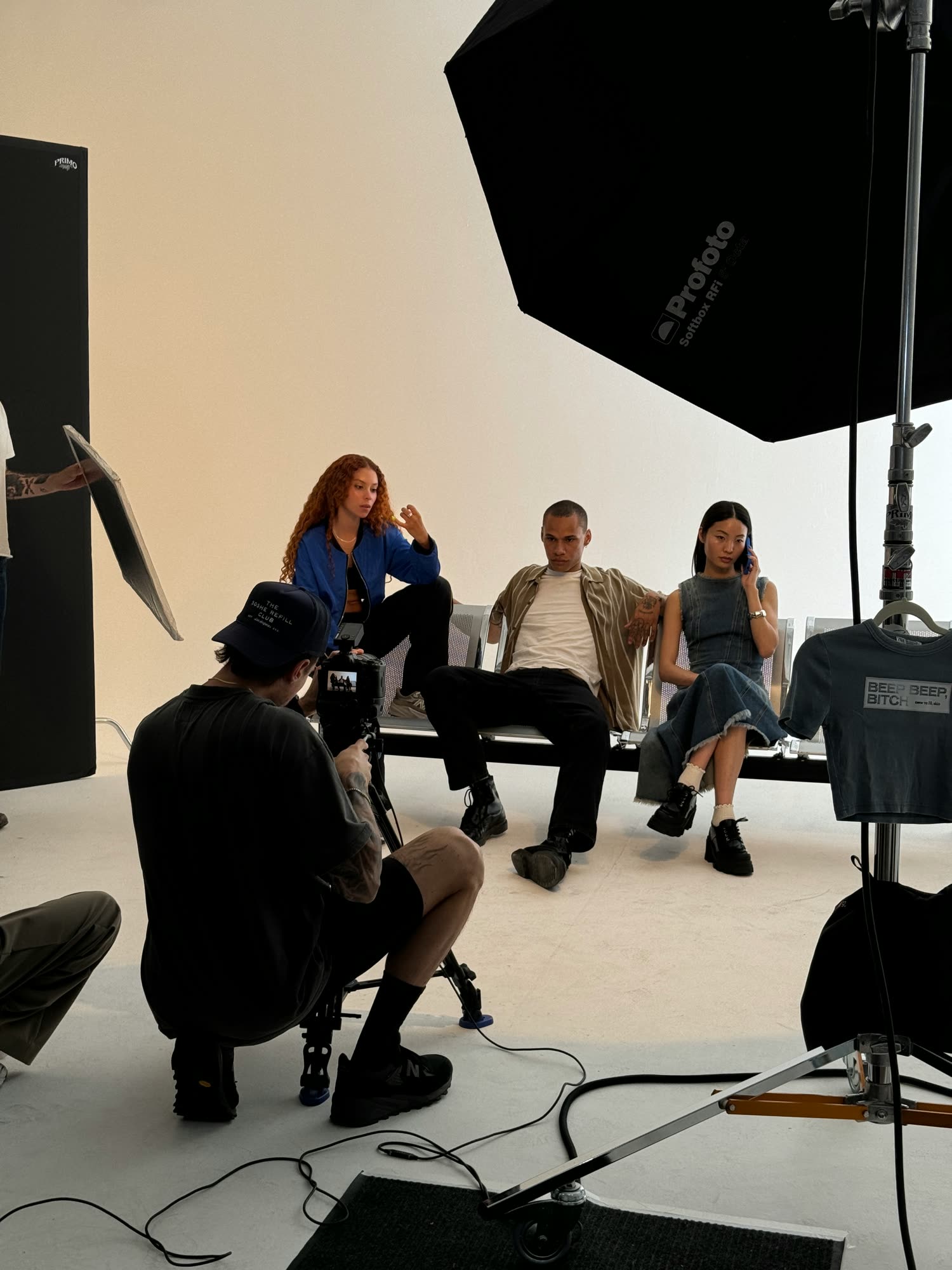
Neither is the whole picture: we classified no shorter B2B videos, and Motion's two top-ranked asset types, "Text only" and "Product image with text", need no person. On our reading, a leader on stage serves a group judging the people it will depend on, and a creator serves a shopper who wants to see someone use the thing. Our UGC page describes that work: "We distribute the task among professional models and creators who can take the job." Under the FTC's Endorsement Guides, a paid creator's material connection must be disclosed when the audience would not expect it.
Is B2B product video a different problem from B2C product video?
Our reading, not a measured result: yes, because what is missing is different. We think of most video requests as a symptom with a condition underneath. For a consumer brand, the symptom is often having nothing to post; the condition, on our reading, is having no steady way to make content at all, which Motion's weekly launch rates make visible.
For a B2B company, on the same reading, the symptom is a request for one product video. The condition is that a buying group averaging 10+ members, over a cycle averaging 10.1 months, never sees one consistent account of what the product does. One polished film does not fix that; a set of cuts that each answer one stakeholder's question might.
Motion adds an outside view on its ranking page: it names "Automotive, Technology, Finance, Travel & Hospitality" as verticals that "expect high-production baseline quality". That is Motion's reading of Meta advertisers, not a B2B study.
Which should you make: B2B-style or B2C-style product video?
Our reading, not a measured result: make the video for the buyer, not the category label. Each price below is our own as of 6 October 2026, credited to the page that carries it.
- If you sell to a buying group of ten or more who take most of a year, make one anchor asset — a keynote, a demo or a launch film — and cut it into shorter pieces sized to each placement's rules, one per stakeholder question. Put your leaders on camera. Write the customer story before you film it.
- If you sell a product whose working is invisible to a technical buyer, make an animated explainer. Our CGI page prices simple 2D at "~$70/sec on average" and complex 3D at "~$300–1,000+/sec", depending on scenes, objects and animation detail.
- If you sell to individual shoppers on Meta, make batches of short creator and product pieces you can replace, and keep high production for scaling an angle that already works. On our UGC page, "On average, pricing starts at $350 per video", with a minimum of 5 videos per batch, so a first batch starts at $1,750.
- If you sell to shoppers in a category that expects polish — technology, finance, automotive, in Motion's list — make one high-production hero and lighter cuts around it. None of our pages we read prices a hero film, so ask for a quote.
- If you sell to both businesses and people, make the first video for whichever buyer pays the bills this year, and say so in the brief. One video asked to serve a committee and a feed will usually serve neither.
Can a Los Angeles video company make B2B video for a San Francisco tech company?
For animation and 3D, the work needs no shoot day; for live action, as of August 2026 Dream Aspect said it was not currently flying crews to shoots and sends or sources local crew. The six steps on our CGI page — discovery, research, design, create, draft, delivery — include no shoot day.
The point against us, stated plainly:
- We have published no software or B2B case study. Our sitemap lists one case study, for a wellness brand. Nothing in this article should be read as saying we have made B2B work.
- Our CGI page is written for consumer brands. Its title reads "CGI Product Videos for Consumer Brands"; the industries it lists are e-commerce and DTC, fashion and beauty, and architecture and real estate. Software is not on the list.
- On the pages we read, our published prices are for consumer-shaped services. UGC on our UGC page, and, in our pricing calculator as of 5 October 2026, live-action shoots at base prices of $4,100 for a one-off shoot and $3,075 a month on a monthly plan for one three-hour social content shoot each month. None of our pages we read offers a B2B package.
- We are based in Los Angeles, and San Francisco comes after Los Angeles and California in the order we take work.
If you sell to a committee and your product's value shows on screen, a screen recording made in-house may serve you better than anything we would build.
Deciding between a B2B and a B2C video plan?
To decide, start from three facts: who signs off on the purchase, how long they take, and where the video will run. The prices cited here are on our CGI and UGC pages and in our pricing calculator; live-action content days are described on our video marketing page. The Dream Aspect pricing calculator lets you choose a one-off shoot or a monthly plan, add or remove deliverables and see the price on the page, or you can send us your brief with those three facts.
Build your quote on the pricing page →
Prefer to talk it through? The same page lets you book a 15-minute call to go over your quote and your dates. Talk to us →
Key takeaways
- 6sense found the average B2B buying cycle fell from 11.3 months in 2024 to 10.1 months in 2025, in a study of nearly 4,000 B2B buyers.
- Forrester's January 2026 release puts the typical business buying decision at 13 internal stakeholders and nine external influencers.
- Motion measured Meta advertisers launching 2.8, 4.1 and 6.6 new creatives a week on average at under $10,000, $10,000–$50,000 and $50,000–$200,000 of monthly spend, between September 2025 and January 2026.
- LinkedIn recommends 15–30-second video ads, so they can qualify for every placement across its Feed and Audience Network, as of 6 October 2026; we found no consumer-platform length recommendation to compare it with.
- Stripe's 11 min 53 s Sessions 2026 cut is 13% of the 91 min 29 s keynote it links to; on our reading, one long asset cut many ways is the B2B pattern.
Frequently asked questions
How long should a B2B product video be?
LinkedIn recommends video ads of 15 to 30 seconds so they can qualify for every placement across its Feed and Audience Network, as of 6 October 2026. That is a placement rule, not a finding about B2B ads. Longer B2B assets exist: Stripe's 2026 keynote runs 91 min 29 s, with an 11 min 53 s cut. Our reading: size each piece to its placement.
Are B2C video ads shorter than B2B video ads?
We cannot say from what we captured. LinkedIn publishes a 15–30-second recommendation so a video ad can qualify for all its placements, but Meta's Reels ads page, the consumer platform page we read, gives no recommended length. Our reading: check each platform's own placement rules rather than a B2B or B2C rule of thumb.
What is the difference between B2B and B2C video marketing?
Mostly the buyer around the video. 6sense found B2B buying groups that average 10+ members (2023–2024) and an average 10.1-month cycle (2025). On the consumer side, Meta advertisers spending up to $200K a month launched 2.8–6.6 new creatives a week on average (Motion). Our reading: B2B video persuades a group slowly; B2C video is replaced.
How many new video ads does a consumer brand launch each week?
Motion measured Meta advertisers launching 2.8 new creatives a week on average under $10K of monthly spend, 4.1 at $10K–$50K and 6.6 at $50K–$200K, from September 2025 to January 2026. Its vertical figures are "an illustrative sample" to use "as directional". Our reading: these describe what advertisers did, not what you need.
Who should appear in a B2B product video?
In Stripe's 2026 keynote, its CEO and its President of Product and Business are on stage, per Stripe's Sessions page. Customer videos are rarer in Stripe's customer index: 4 of 36 story links are videos. We did not classify shorter B2B videos. Our reading: write the customer story first, then film whoever agrees.
How much does a product video cost from Dream Aspect?
Our CGI page prices simple 2D at about $70 per second on average and complex 3D at about $300–1,000+ per second, depending on scenes and detail. Our UGC page says "On average, pricing starts at $350 per video", with a five-video minimum, so a first batch starts at $1,750. Our pricing calculator lists a base price of $4,100 for a one-off live-action shoot. None of our pages we read offers a B2B package.
Can a Los Angeles company make B2B videos for a San Francisco startup?
With limits stated up front. CGI and animation on our CGI page involve no shoot day. For live action, as of August 2026 Dream Aspect said it was not currently flying crews to shoots and sends or sources local crew. We have not published a software or B2B case study.
- 6sense 6sense.com
- homepage 6sense.com
- LinkedIn business.linkedin.com
- Config FAQ config.figma.com
- CGI page Dream Aspect
- Contact us Dream Aspect
- How Many Videos Per Month Dream Aspect
- Pricing calculator Dream Aspect
- UGC page Dream Aspect
- video marketing Dream Aspect
- Endorsement Guides ecfr.gov
- Reels ads page facebook.com
- Forrester forrester.com
- LinkedIn recommends linkedin.com
- "an illustrative sample" motionapp.com
- Creative Benchmarks 2026 motionapp.com
- homepage motionapp.com
- Motion motionapp.com
- Motion's asset-type ranking motionapp.com
- customer index stripe.com
- release stripe.com
- Sessions page stripe.com
- 11 min 53 s youtube.com
- 91 min 29 s youtube.com
- film youtube.com