


Why did our product launch get zero engagement?
Often the launch did less badly than it looks. Instagram's all-industry median engagement rate is 0.30% of followers per post, according to Quid's 2026 Social Media Industry Benchmark Report, so a typical post from a 2,000-follower account gets about 6 interactions. And about 70% of a post's views arrive in its first three days, according to Metricool's 2026 Instagram study, so the verdict comes faster than new content can be made.
Before you blame the creative on Instagram, check five things in order: the benchmark, the timing, the reach, the call to action and the audience. The checklist is at the end of this article.
What is a normal Instagram engagement rate?
A normal Instagram engagement rate is about 0.30% of your followers per post. That is the all-industry median in Quid's 2026 benchmark, down from 0.36% in its previous report. Quid divides total interactions by follower count, not by reach or impressions, so you can check your own post in seconds:
- 2,000 followers: about 6 interactions.
- 5,000 followers: about 15 interactions.
- 10,000 followers: about 30 interactions.
For a small account, the gap between a launch that flopped and a perfectly median post can be a handful of taps. For benchmarks by platform, account size and format, see what a good engagement rate is in 2026.
Why 0.30% is only a rough guide
Quid's figure is a sanity check, not a target. It is a median across companies, not a measure of launch posts specifically. Its sample is 150 companies per industry across 18 industries, drawn from a database of more than 200,000 national and international companies, which are likely larger than a brand launching its first product. It mixes organic and paid posts. And Quid finds Retail and Beauty near the bottom for Instagram engagement, which are exactly the categories where many product launches happen. That last point makes a low number more normal, not less.
How long should you wait before judging an Instagram post?
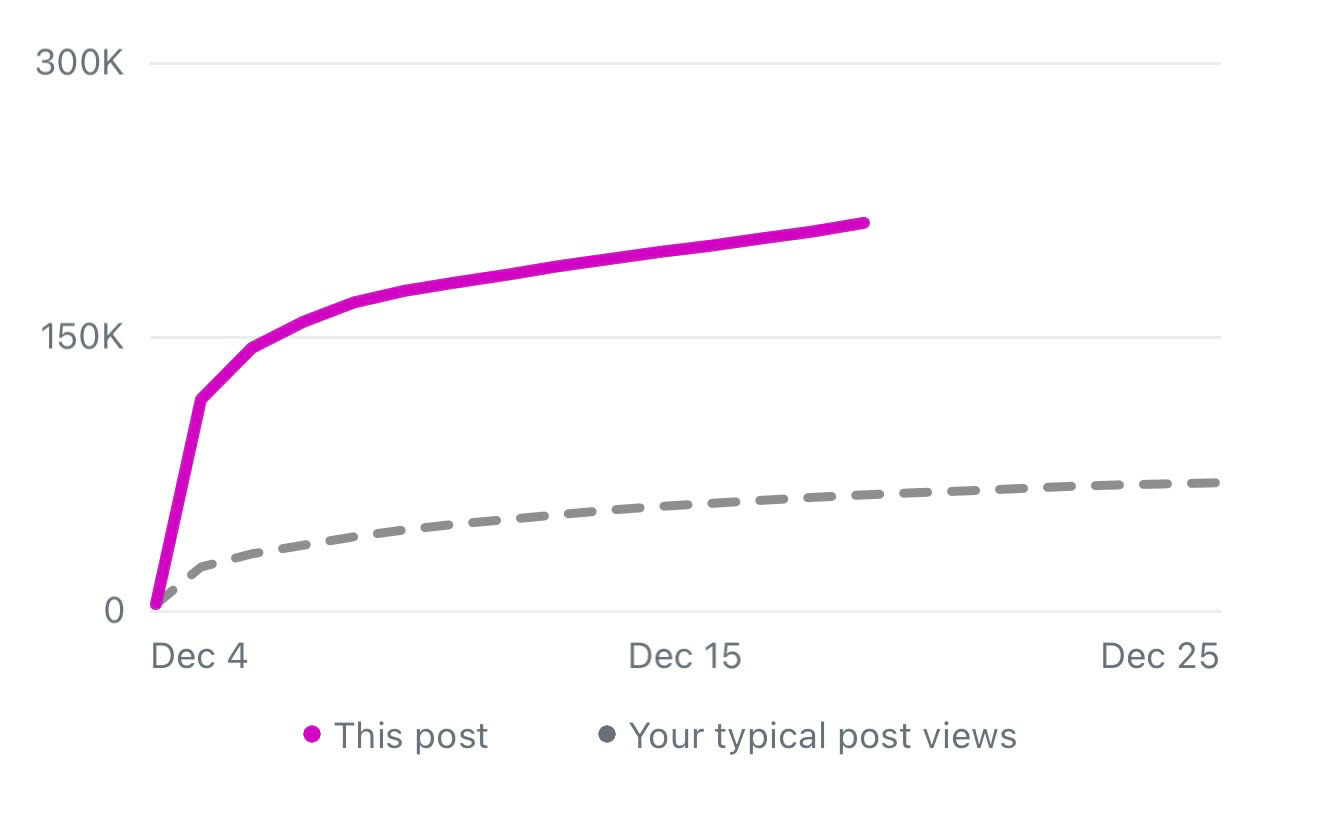
About three days. Metricool's 2026 study of 24,364,803 posts from 375,118 accounts found that roughly 70% of a post's total views arrive in its first three days. The split by format:
- Reels: about 65% of views and 61% of interactions arrive in days 1–3, and around 30% of lifetime views arrive on day one.
- Static posts and carousels: about 76% of views and 75% of interactions arrive in days 1–3, and roughly 44% of lifetime views arrive on day one.
If your launch post is already several days old, waiting longer is unlikely to change the result. The useful question becomes what you post next.
Why can't we just make better content and try again?
Because the feedback arrives faster than new content can. As of 5 October 2026, Dream Aspect's video marketing page says "Full content delivery typically takes 7-10 days after the content shoot day." Against a three-day decision window, that is 2.3 to 3.3 times longer, and the clock only starts once the shoot has happened. "Typically" is not a minimum.
Here is how a reactive launch plays out:
- Day 0: the launch post goes live and distribution starts.
- Day 1: a large share of lifetime views has already arrived. You can still reply to comments, reshare to Instagram Stories, message customers and activate partners.
- Day 3: about 70% of views are in, and you can tell the post is weak.
- After day 3: you start organising replacement creative. A new shoot needs planning first, then the shoot itself, and only then does the 7–10-day delivery window begin.
By the time new footage arrives, the launch moment has usually passed. That is why the response content has to exist before launch day. For how brands keep that material ready, see what a content production engine is.
Should you tag other accounts in a launch post?
Yes, especially if your account is small. Metricool's 2026 analysis found that mentioning another account went with higher reach, and the smaller the account, the bigger the difference:
- Under 2,000 followers: about 108% higher reach.
- 2,000–10,000 followers: about 37% higher.
- 10,000–100,000 followers: about 31% higher.
- 100,000–1 million followers: about 9% higher.
- Over 1 million followers: about 4% higher.
These are associations in observed data, not controlled experiments, but tagging a genuinely relevant partner, stockist or creator costs nothing.
What call to action should a launch post use?
Ask for the action you actually want. In Metricool's 2026 data, the wording of the ask lined up with very different results:
- Asking for comments: about 203% more comments.
- Asking for saves: about 92% more saves.
- Asking for likes: about 4.9% fewer likes.
- Asking a question in the caption: about 37% more comments.
Again, these are observed relationships rather than experiments, so treat them as a starting point to test.
Was the audience the problem?
Possibly. A launch asks people to pay attention and act at the same moment, which is hard if your audience is small, inactive or new to the brand. You can't build months of familiarity during launch week, but you can change who sees the post. For accounts under 2,000 followers, Metricool links account mentions with roughly double the reach, which makes tagging the quickest way to put a launch in front of new people.

Does posting more often increase Instagram engagement?
Not simply. Quid puts the median company at about 3.69 Instagram posts a week. Metricool finds that accounts with 2,000–10,000 followers see peak interactions at around 7–14 posts a week. The two studies measure different things, so they shouldn't be compared directly.
More production is not automatically the answer either. The one recurring production figure we have, from an internal call record, is 15 videos a month for a single brand, about 3.5 a week. That is one unpublished operating figure, not a benchmark, and it counts videos produced rather than posts published. For what one brand did instead, see how Dream Aspect grew a wellness brand from 3.2M to 14.8M on Instagram in 2025.
How do you diagnose a quiet product launch?
Work through five checks, in this order, before deciding the creative failed:
- Benchmark the result. Multiply your follower count by 0.003. If your interactions are close to that number, the launch performed about like a median Instagram post.
- Check the timing. Look at the first three days, when about 70% of views arrive. If the post is older than that, focus on the next post instead of waiting.
- Check the reach. Did you tag relevant accounts, reshare to Stories and message existing customers? For small accounts, mentions are linked to the biggest reach gains.
- Check the call to action. Did the caption ask for a comment, a save or an answer to a question? Asking for likes is linked to fewer of them.
- Check the audience. If the account is small or new, the problem may be who saw the post, not what it said.
Planning your next launch?
The fix for a quiet launch is having response content ready before launch day: alternative hooks, product demonstrations, founder videos, testimonials and short cutdowns you can post the moment the first numbers come in. Dream Aspect is a Los Angeles-based content production agency that shoots this kind of launch content, and you can see what it costs on the Dream Aspect pricing calculator: choose a one-off shoot or a monthly plan, add or remove deliverables, and see your price on the page.
Build your quote on the pricing page →
Prefer to talk it through? The same page lets you book a 15-minute call to go over your quote and your launch date. Talk to us →
Key takeaways
- Instagram's all-industry median engagement rate is 0.30% of followers per post, so a typical post from a 2,000-follower account gets about 6 interactions (Quid, 2026).
- About 70% of a post's views arrive in its first three days, so you will know how a launch post did within about 72 hours (Metricool, 2026).
- New footage typically takes 7–10 days after the shoot day to deliver, 2.3 to 3.3 times longer than that window, so response content has to be made before launch.
- For accounts under 2,000 followers, mentioning another account goes with about 108% higher reach.
- Asking for comments goes with about 203% more comments, while asking for likes goes with about 4.9% fewer likes.
Frequently asked questions
What is a good Instagram engagement rate for a small brand?
About 0.30% of followers per post, the all-industry median in Quid's 2026 benchmark. That is roughly 6 interactions per post at 2,000 followers and 15 at 5,000. Quid's sample is national and international companies, and it divides interactions by followers rather than reach, so use 0.30% as a reference point rather than a target.
How many days until I know whether a launch post worked?
About three. Metricool's 2026 study found roughly 70% of a post's views arrive in the first three days: about 65% for Reels and 76% for static posts and carousels. Day one alone brings around 30% of a Reel's lifetime views and 44% of a static post's.
Can an Instagram post recover after a slow start?
Sometimes. Metricool notes that Instagram can show content again to people who did not engage the first time, and carousels benefit most from repeat exposure. But most views still arrive in the first few days, so treat a late recovery as a bonus, not the plan.
Should I delete a launch post that underperformed?
Usually not. Neither Quid's benchmark nor Metricool's study shows that deleting a weak post improves future performance, and by day three most of its distribution has happened anyway. Put the effort into the next post: a stronger call to action, a tagged partner, a Stories reshare or a different creative angle.
Is Instagram engagement declining?
It depends what you measure. Quid's all-industry median fell from 0.36% to 0.30%, about 17% lower, though Quid also added five industries to its benchmark. Metricool, measuring by format, found Reels engagement up 24.76%. The studies measure different things, so the fair answer is that engagement is moving differently by account, format and metric.
Do hashtags still help Instagram launch posts?
Less than they used to. In Metricool's 2026 data, posts with hashtags had 31% fewer views and 33% fewer interactions than posts without them. Metricool treats that as correlation, not proof that hashtags hurt. Lead with a clear caption, searchable keywords and a strong hook; a few relevant hashtags can add context but should not carry distribution.
How fast can an agency turn around new launch content?
For new footage, look at the whole timeline, not just editing. Dream Aspect's video marketing page says full content delivery typically takes 7–10 days after the shoot day, and planning and scheduling come before that. Against a three-day performance window, footage commissioned after a weak launch usually arrives too late for that launch.
We have a product launch in six weeks. What should we do differently?
Make the response content before launch day. Have alternative hooks, product demonstrations, founder videos, testimonials, carousels and short cutdowns ready, so you can post a new angle as soon as the first numbers come in. Launch week then becomes a testing and distribution job, not a production scramble.


