

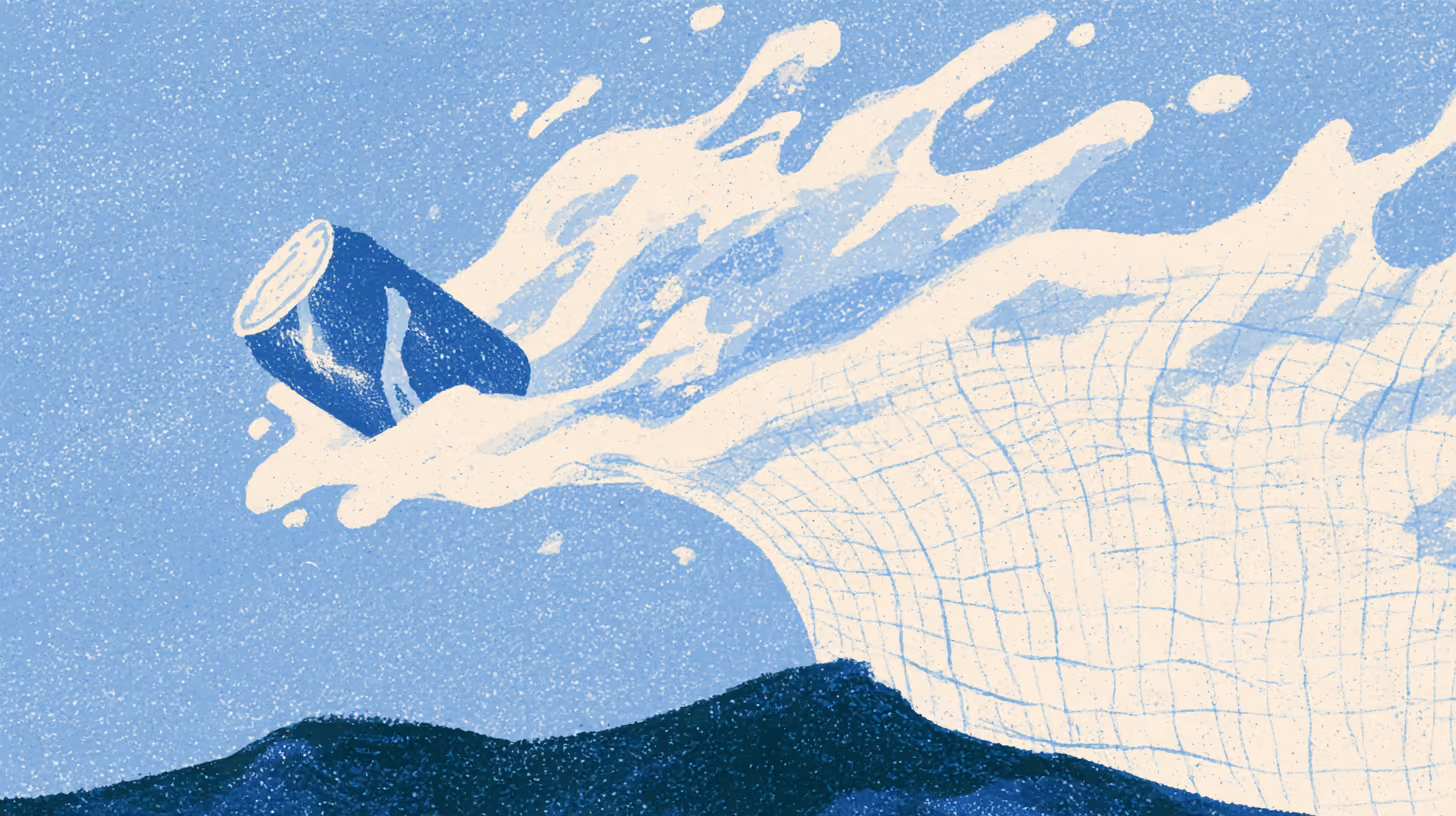
When should a beverage brand use CGI instead of a live liquid shoot?
Use CGI when the can, bottle or flavour is not produced yet, when one 3D model must cover several flavours or SKUs, or when the pour is physically impossible. Film real liquid when hands, faces and an existing product carry the shot. Dream Aspect's CGI page prices simple 2D at about $70 a second, with 7–12 seconds in about 2–5 days, and complex 3D at about $300–1,000+ a second. For alcohol, as of 26 October 2026, Meta bars ads targeted under 18 and sets 21 in the United States.

At a glance:
- Simple 2D CGI: about $70 per second, and about 2–5 days for 7–12 seconds
- Complex 3D, where a photoreal pour sits in our reading: about $300–1,000+ per second, 2 weeks to a month per piece
- Meta alcohol ads: never targeted under 18, 21 in the United States, banned in countries including Norway and Saudi Arabia
- TikTok alcohol ads: no retail or delivery ads; US and Canadian advertisers must clear eligibility with a TikTok sales representative
- US federal rules: TTB rules cover social media ads and require mandatory statements
What is beverage CGI, and what does it have to simulate?
Beverage CGI is a product video in which the can or bottle, the drink inside it and everything on its surface are built, simulated, lit and rendered in software instead of filmed. XO3D's food and drink page says liquids require subsurface scattering simulation, correct refraction through glass and accurate colour behaviour depending on liquid depth. PICS sells beverage, alcohol and liquid simulation CGI, and its DeLeón Tequila case study for Droga5 London recreated the bottle for animated films and stills. Those are vendors describing their own craft, not independent tests.
Condensation is usually a separate job from the pour. In Imaginar's artisanal coffee cup CGI project, the studio built procedural shaders for liquid coffee, cream swirls, transparent plastic, condensation droplets and ice refraction. Splashes are another job: the Share a Coke end-tag write-up on Vimeo says Fusion built two kinds of mid-air CG fluid splashes, one of them bursting from the bottle. In our reading, each element adds production hours, and hours are what a CGI quote is priced on.
How does a live-action liquid shoot work?
A tabletop shoot is a live-action shoot in which the pour, the splash or the ice drop happens for real in front of the camera, often a high-speed one. PetaPixel reported that Steve Giralt built a rig spinning a Phantom VEO 4K camera around a tabletop subject at 150 rotations per minute, for a Jack Daniel's Honey shoot in which the camera had to show a lime completing a full turn before it dropped into the drink.
The American Society of Cinematographers treats the pour as its own lighting problem in Lighting a Beer Pour – Moving the Camera, part of a series on a tabletop beer commercial. Storyblocks lists a milk pour shot on a Phantom Flex 4K at 1000 fps. We did not find a rental rate or crew cost for a Phantom shoot, so price a live pour from real quotes. Dream Aspect's studio vs location guide for Los Angeles compares where to film one.
Which beverage shots favour CGI, and which favour a real pour?
Dream Aspect's guide to CGI vs live action product video lists one case for CGI as a single model that must produce many colors, configurations, markets or future versions. Imaginar's CGI bottle imagery page describes a digital bottle that can be updated for a new flavour, a seasonal edition or a market-specific label, then re-rendered. A wine-focused article from Outshinery says that when a label changes, only the label file needs updating while the model stays the same.
Imaginar's Fever-Tree bottle breakdown shows what a studio needs for that: physical bottles to measure, the original label print files, PDF blueprints and product photography for the liquid colour. The label files were converted to wrap around the 3D bottle, and the output covered four variants, Worldwide and German labels at 200ml and 500ml. XO3D says CGI built from packaging specs and label files lets a brand shoot a new product before any units are bottled.
Choose CGI for a drink when:
- The can, bottle or flavour is not produced yet
- One model has to carry several flavours, SKUs, label changes or markets
- The shot is physically impossible, such as a splash that wraps around the bottle or a camera inside the product
Film a real pour when:
- The product exists, photographs well, and the brief is simple and time-sensitive
- Hands, faces or someone drinking carry the story
- The real texture of the drink is the selling point
LutherMEB, which mainly sells live-action production and photography, names food and liquids among the hard cases for CGI, as Dream Aspect's guide reports, while XO3D, PICS and Imaginar sell liquid CGI. In our reading, both can be right: photoreal liquid is possible in CGI, but it adds hours to every second. Dream Aspect sells both CGI and live action.
How much does beverage CGI cost, and how long does it take?
Dream Aspect's CGI page prices by finished second, as published on 5 October 2026. Simple 2D runs about $70 per second on average, so a 7–12 second piece is about $490–$840. Complex 3D runs about $300–1,000+ per second. The page says "A complex 3D animation may require 6–10+ hours per second", and ties that range to scenes and objects, animation detail and dynamics, and effects, lighting and rendering time. Every tier is in how much CGI product animation costs. We found no published beverage-specific CGI price or timeline.
Dream Aspect's published production windows:
- Simple 2D: about 2–5 days for 7–12 seconds
- Moderate 2D or basic 3D: about 5–10 days per piece, with no published rate
- Complex 3D or animated VFX: 2 weeks to a month per piece
- Live action, for comparison: typically delivered 7–10 days after the shoot day, per Dream Aspect's video marketing page
In our reading, a photoreal pour with simulated liquid, refraction and condensation belongs in the complex 3D tier, because dynamics, effects, lighting and rendering time are the page's named drivers. At $300–1,000+ per second, 7–12 seconds of complex 3D is about $2,100–$12,000+, by our arithmetic. LutherMEB's London comparison, reported in Dream Aspect's guide, puts a CGI product film at £8,000–£40,000 against £5,000–£15,000 for comparable live action; use the ratio, since LutherMEB sells live action.
Before you approve a beverage CGI quote, check that it names:
- the seconds of finished output, and how many flavour or SKU versions
- the tier, and whether the liquid is simulated, filmed and composited, or left out
- the hours-per-second basis, and what moves the price
- an animatic step, so camera angles and splash timing are approved before the simulation runs
- the production window, and what you supply: CAD files or references and every label file
What are Meta's rules for alcohol ads?
Meta's alcohol policy in its Advertising Standards sets an age floor for every alcohol ad: "At a minimum, ads may not be targeted to people under 18 years of age." Local law then raises it. As of 26 October 2026, the country list on the Spanish-language version of the policy sets 21 for the United States, 25 for Sweden, 20 for Japan and 19 for Korea.
Meta's alcohol policy also prohibits ads promoting or referencing alcohol in some countries, based on local law, so check each market before you book media. Meta's list, as of 26 October 2026, includes:
- Afghanistan, Bangladesh, Brunei, Nepal and Pakistan
- Egypt, Kuwait, Libya, Saudi Arabia, the UAE and Yemen
- Lithuania, Norway, Russia and Turkey
- Gambia, Thailand and several Indian states
Meta's rules change, and old summaries drift: Jon Loomer's third-party summary, which warns that its screenshots may be outdated, gives Turkey an age minimum, while Meta's own page lists Turkey as prohibited, so trust only Meta's live page.
What are TikTok's rules for alcohol ads?
TikTok's alcohol ads policy sets rules for all countries and a gate for North America: in the US and Canada, all potential advertisers must work with a TikTok sales representative to determine eligibility. The policy also says "TikTok does not allow retail or e-commerce advertisements that promote the sale of alcohol or alcohol delivery services." As of 26 October 2026, TikTok bars ad content and landing pages that:
- target people under the legal drinking age
- feature people under the age of 25, or pregnant people
- portray excessive drinking, intoxication or reckless behaviour under the influence
- offer alcohol as a prize or reward
- promote offers or incentives that encourage drinking, such as discounts
The pages we found do not settle TikTok's US age threshold. Brewbound's 2024 report on TikTok opening its ad platform to beverage-alcohol brands says alcohol ads may be shown only to users 25 and older. TikTok's own business verification help page lists the minimum age for alcohol as 21 or older for the United States, and TikTok's Argentina rules restrict ads to viewers aged 18 and older. Check TikTok's alcohol market-specific requirements for your market before launch.
What do US federal rules and industry codes add to an alcohol ad?
The TTB, the US Alcohol and Tobacco Tax and Trade Bureau, says in Industry Circular 2024-1 that its advertising rules in 27 CFR parts 4, 5 and 7 cover all advertising in any medium, including social media. Those rules require mandatory statements, such as the responsible advertiser's name and address, in wine, spirits and malt beverage ads. TTB generally treats a whole page as one ad, so the statements appear once but must be conspicuous and readily legible. For malt beverages, the federal rules apply only where state law imposes similar requirements.
The industry codes are voluntary, and they set where alcohol ads may run. The DISCUS Code of Responsible Practices calls for spirits ads to run mainly in media where 73.8% of the audience is expected to be 21 or older, up from 71.6% after the 2020 Census, per DISCUS's announcement. Brewbound reports that the Beer Institute's code sets the same 73.8% floor for adults of legal drinking age.
Know which of your drink shots to render and which to pour? The Dream Aspect pricing calculator shows the price on the page: choose a one-off shoot or a monthly plan, then add or remove deliverables such as a shoot brief, priority delivery, CGI or UGC.
Build your quote on the pricing page →
Prefer to talk it through? Talk to us → or book a 15-minute call from the pricing page.
Key takeaways
- Use CGI for a drink that is not produced yet, a flavour range that shares one model, or an impossible pour; film real liquid when hands, faces and an existing product carry the shot.
- Dream Aspect's CGI page prices simple 2D at about $70 per second, with 7–12 seconds in about 2–5 days, and complex 3D at about $300–1,000+ per second, 2 weeks to a month per piece.
- In our reading a photoreal pour sits in complex 3D, so 7–12 seconds of it is about $2,100–$12,000+ by our arithmetic.
- As of 26 October 2026, Meta bars alcohol ads targeted under 18, sets 21 in the United States and prohibits them in countries including Norway and Saudi Arabia.
- TikTok makes US and Canadian alcohol advertisers clear eligibility with a sales representative and bars anyone under 25 on screen; in the US, TTB says its ad rules cover social media, and the DISCUS and Beer Institute codes set a 73.8% adult-audience floor.
Frequently asked questions
Is CGI cheaper than filming a real pour?
Not for one film of a drink that already exists, on the figures we found. LutherMEB's London comparison, reported in Dream Aspect's CGI vs live action guide, puts a CGI product film at £8,000–£40,000 against £5,000–£15,000 for comparable live action. CGI pulls ahead when one model is reused across flavours, SKUs, markets or later versions. LutherMEB mainly sells live action, so use the ratio, not the pounds.
How much does a CGI drink pour cost?
About $300–1,000+ per second if it lands in the complex 3D tier on Dream Aspect's CGI page, which in our reading is where photoreal liquid sits. By our arithmetic, 7–12 seconds of complex 3D is about $2,100–$12,000+. Simple 2D, such as an animated label on a flat can, is about $70 per second. We found no separate rate for liquid simulation on the page.
How long does beverage CGI take to make?
From about 2–5 days to a month, depending on the tier. Dream Aspect's CGI page gives about 2–5 days for 7–12 seconds of simple 2D, about 5–10 days for moderate 2D or basic 3D, and 2 weeks to a month for complex 3D or animated VFX. None of those windows is a delivery commitment, so get any launch date in writing.
Can CGI show condensation and ice convincingly?
Studios that sell drinks CGI say it can, and they treat each surface as its own material. Imaginar's coffee cup project built separate procedural shaders for condensation droplets, ice refraction, liquid coffee, cream swirls and transparent plastic. Those are portfolio claims from a vendor, not independent tests, so ask for a still of your own can with condensation before the animation is approved.
What age must Meta alcohol ads target?
At least 18 everywhere, and higher where local law says so. Meta's alcohol policy says "At a minimum, ads may not be targeted to people under 18 years of age." Its country list sets 21 for the United States, 25 for Sweden, 20 for Japan and 19 for Korea, as of 26 October 2026. Some countries, including Norway, Saudi Arabia and Russia, are on Meta's list of countries where alcohol ads are prohibited.
Can a US drinks brand run alcohol ads on TikTok?
Only once TikTok clears it. TikTok's alcohol ads policy says all potential advertisers in the US and Canada must work with a TikTok sales representative to determine eligibility. Even then, TikTok bars alcohol retail and delivery ads, discounts that encourage drinking, and anyone under the age of 25 on screen. Brewbound's 2024 report says ads may be shown only to users 25 and older, while TikTok's business verification page lists 21 or older for US alcohol.
Does making an alcohol ad in CGI change the platform rules?
No. The platform rules apply to the ad, not to how it was made, so a rendered RTD cocktail can faces the same Meta and TikTok targeting limits as a filmed pour. In our reading, CGI helps with one TikTok content rule only: a spot built from the product, liquid and ice has no cast, so nobody on screen has to be checked against the age of 25.
Do TTB rules apply to alcohol ads on social media?
Yes. The TTB's Industry Circular 2024-1 says its advertising rules in 27 CFR parts 4, 5 and 7 cover all advertising in any medium, including social media. Wine and spirits ads, and malt beverage ads where state law imposes similar requirements, need mandatory statements, such as the responsible advertiser's name and address, shown conspicuously at least once on the page. The circular is TTB's interpretation, so confirm the current regulation text with counsel.
Sources
American Society of Cinematographers
- Lighting a Beer Pour – Moving the Camera — instructional series on lighting and shooting a tabletop beer commercial
Brewbound
- TikTok Opens Ad Platform to Beverage-Alcohol Brands in the US — 2024 report: alcohol ads shown only to users 25 and older
- BI Updates Advertising Code, Including Social Media Content Compliance Language — Beer Institute code: expected audience at least 73.8% adults of legal drinking age
Distilled Spirits Council (DISCUS)
- DISCUS Code of Responsible Practices (2023) — ads mainly in media where 73.8% of the audience is expected to be 21 or older
- Distillers Adopt 73.8% 21+ Demographic Placement Standard — up from 71.6% after the 2020 Census
Imaginar
- artisanal coffee cup cgi renders 3d product visualisation — procedural shaders for condensation droplets and ice refraction
- cgi images bottles — one digital bottle updated for a new flavour, seasonal edition or market label
- Fever Tree CG Render Bottle Breakdown — inputs supplied and four label and size variants
Jon Loomer
- facebook advertising guidelines targeting — older third-party summary of Meta's alcohol age minimums
Meta
- Advertising Standards: Alcohol (transparency.meta.com) — no targeting under 18; countries where alcohol ads are prohibited
- Advertising Standards: Alcohol, Spanish-language version (transparency.meta.com) — country minimums, including 21 in the United States and 25 in Sweden
Outshinery
- how 3d product rendering works for beverage brands — a label change updates only the label file; the model stays the same
PetaPixel
- This Crazy Camera Rig Spins a Phantom Camera at 150RPM — Phantom VEO 4K rig at 150 rotations per minute for a Jack Daniel's Honey shoot
PICS
- Drinks CGI Studio | Beverage, Alcohol & Liquid Simulation CGI | PICS — a studio selling drinks and liquid simulation CGI
- Deleon - DROGA5 | CGI Animation, Product Animation | PICS — the DeLeón Tequila bottle recreated for animated films and stills
Storyblocks
- Milk pouring and splahsing in slow motion; shot on Phantom Flex 4K at 1000 fps — stock pour footage at 1000 fps
TikTok
- TikTok ads policy: alcohol — US and Canada eligibility through a sales representative; no alcohol retail or delivery ads; no people under 25
- About business verification for TikTok accounts — minimum age for alcohol listed as 21 or older for the United States
- Alcohol: Market-specific requirements — the per-market alcohol rules to check before launch
TTB
- TTB Industry Circular 2024-1 — 27 CFR parts 4, 5 and 7 cover advertising in any medium, including social media; mandatory statements
Vimeo
- Share A Coke — mid-air CG fluid splashes for a Share a Coke end tag
XO3D
- XO3D Studio · Industry — liquids require subsurface scattering, refraction through glass and depth-dependent colour; CGI from packaging specs and label files before bottling
Dream Aspect
- CGI Production — simple 2D of 7–12 seconds in about 2–5 days
- How Much Does CGI Product Animation Cost? Our Rates and Production Windows by Complexity Tier — about $70 per second for simple 2D, about $300–1,000+ for complex 3D, and production windows by tier, as of 5 October 2026
- When Should You Use CGI Instead of Live Action for Product Video? — when CGI beats live action; LutherMEB's London comparison
- Video marketing — live action delivered 7–10 days after the shoot day