
What permits do you need to film driving and car shots for a brand video in Los Angeles?
On City of Los Angeles streets you need a FilmLA permit, with a $931 application fee and at least three full business days' notice, plus LAPD motorcycle officers for camera-car work: a minimum of 2 for an insert car and 3 with a process trailer, as of 16 November 2026. Freeways and state highways need a separate California Film Commission permit, filed four business days ahead, with Caltrans and the CHP.
- City streets: FilmLA's $931 application fee covers up to 5 locations over 7 consecutive days.
- Police: at least 2 LAPD motorcycle officers for an insert car, 3 when it tows a process trailer.
- Closures: traffic plans, officers at each intersection and a $312 City lane and street closure fee per location.
- State highways: a free CFC permit, 4 business days ahead; 12 to 16 business days when lanes or freeways close.
- Insurance: $1,000,000 general liability, and on state property $1,000,000 auto liability per accident as well.
Cars are central to Grand Theft Auto, and Rockstar Games lists GTA 6's release date as November 19, 2026, so brands are asking for night drives, street-racing energy and gleaming paint. Build that feeling with your own product and your own cars, never the game's footage, logos or type. Dream Aspect is not affiliated with, endorsed by or sponsored by Rockstar Games or Take-Two Interactive. This article explains public permit rules; it is not legal advice, so confirm your plan with FilmLA, the agencies and counsel.
Do you need a FilmLA permit to film a car on a Los Angeles street?
Yes, for any commercial shoot. FilmLA's City of Los Angeles page says a temporary use (filming) permit is required for all on-location filming of a commercial nature, on public and private property. As of 16 November 2026 (page last published 30 October 2026), the application fee is $931 for up to 5 locations over 7 consecutive days. Applications are due in MyFilmLA by 10 a.m., processing takes at least three full business days not counting the day you submit, and stunts, special effects and closures need extra lead time.

Unincorporated Los Angeles County runs on similar rules through FilmLA's County page: three full business days for a standard permit, 4 to 7 days before the first activity, prep day included, for high-impact work such as closures, and most County approval offices are closed on Fridays. In both the City and the County, cast and crew cars must park on private property, not public streets. In the City, Temporary No Parking signs for production vehicles need 3 full working days' notice, and the posting fee is $69 per 300 feet of curb. Other cities in the county were not checked for this article.
What does LAPD require for running shots, insert cars and process trailers?
FilmLA's LAPD Motion Picture Officer Hire Assignments page, last published on 1 April 2026, sets officer numbers for each driving activity in the City of Los Angeles. “The assignment numbers listed in this document are minimums”, FilmLA writes, and productions remain responsible for asking for more officers when their own judgement says the shot needs it. Retired or active off-duty LAPD officers are sometimes required for film set supervision, and the activity written on the permit decides how many.
- Running or driving shots with the flow of traffic, with equipment into the adjacent lane (the page's example is a hostess tray): minimum 2 motorcycle officers.
- Insert car without a trailer: minimum 2 motorcycle officers, after LAPD review of location, time of day and traffic volume.
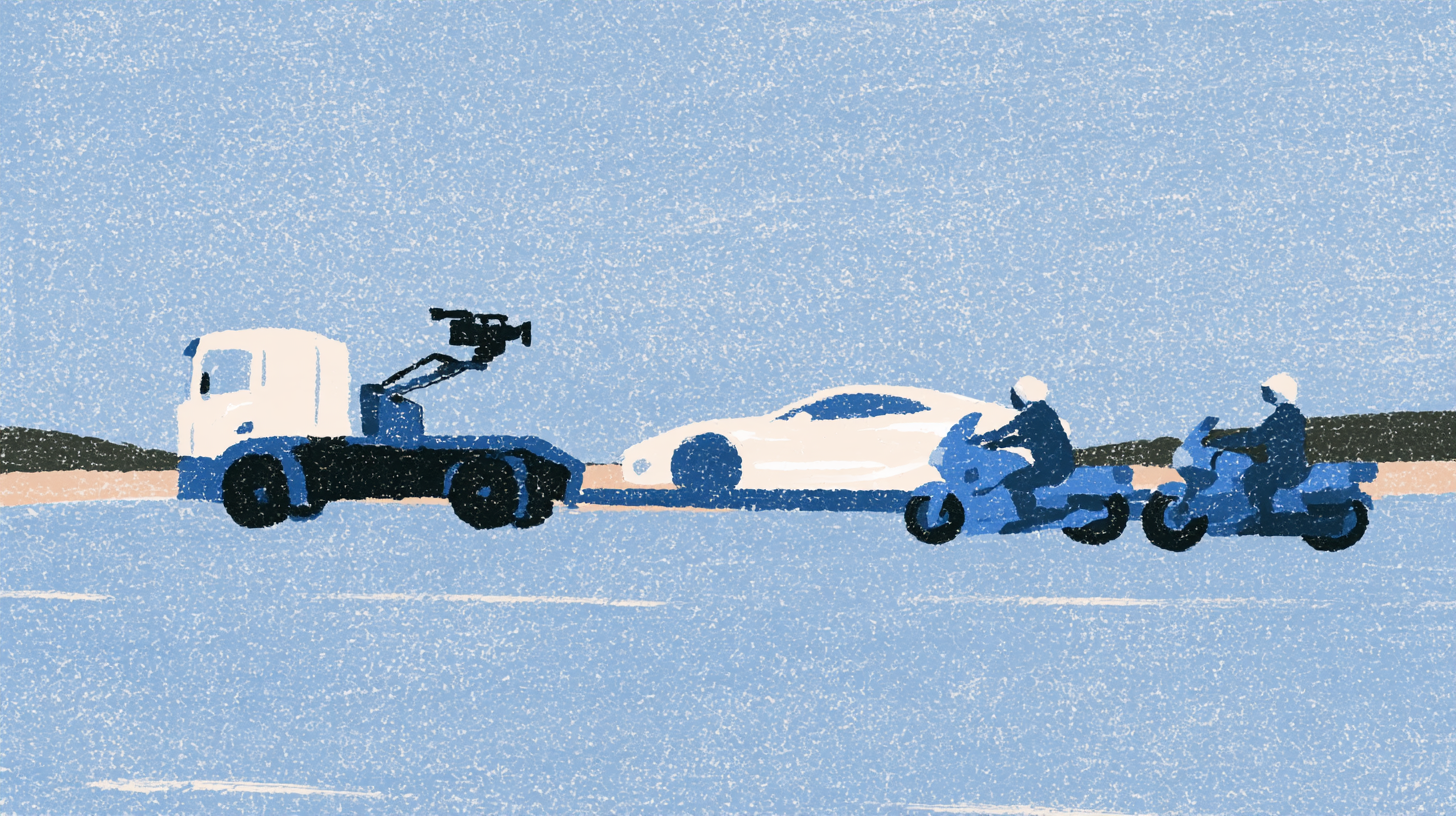
- Insert car with a process trailer: minimum 3 motorcycle officers, after the same LAPD review.
- Pod cars or a Russian arm: minimum 2 motorcycle officers each.
- Stunt or precision driving: LAPD review and traffic plans; a simulated vehicle pursuit on a closed road also needs at least 1 officer and notice to the Area Watch Command.
A process trailer is towed by a camera car or heavier equipment and is built to carry people, equipment or other vehicles, according to the industry's Safety Bulletin #8, Addendum A (revised 28 August 2012). The bulletin treats anything the camera car tows as part of the camera car and says “Only essential persons required for the shot shall be on the towed vehicle”. FilmLA's City fee list puts retired or off-duty LAPD officers at $67.19 to $77.90 an hour with an 8-hour minimum, plus a $75 daily motorcycle fee, paid to the provider rather than to FilmLA.
How do traffic control and street closures work for a car shoot in Los Angeles?
LAPD officer minimums for traffic control are set out on FilmLA's hire assignments page. Intermittent traffic control (ITC) on a two-way street needs one officer at the start of the traffic break in each direction, so at least 2, and FilmLA allows only the two-minute standard ITC; a one-way street needs 1 officer, and a major thoroughfare is decided case by case. A traffic lane closure needs at least 1 officer and a traffic plan, a full street closure needs an officer at each intersection and end, at least 2, and holding intersections takes 4-6.
FilmLA's City fee list, as of 16 November 2026, adds a $78 lane closure administration fee and a $312 City lane and street closure fee per involved location, on top of officer hours. Active-duty LAPD officers are listed at $74 an hour with a 2-4 hour minimum. Our reading, from Dream Aspect's production side: a two-minute hold is enough for a short drive-by or a reveal, so plan each take to fit inside one traffic break rather than asking for a closure you do not need.
Do you need a California Film Commission permit and the CHP to film on a freeway?
Yes. The California Film Commission (CFC) issues permits for filming on state highways and freeways, and its Caltrans Highways and Freeways page asks for applications at least four business days (96 business hours) ahead, or twelve for drones and freeway or road closures. The CFC permit FAQ gives 12 business days for ramp and lane closures and 16 for freeway closures, so plan for the longer figure. Interstates, marked with a blue shield, also need Federal Highway Administration approval, which takes at least 30 days.
“The CHP is the liaison for filming on all state roads, freeways, and unincorporated county roads throughout the state”, the CFC FAQ says, and it asks you to contact the CHP at least 4 business days ahead so the CHP can decide whether officers are needed. The CFC charges nothing for its permit, but its fee page lists Caltrans review and monitoring at $181.00 an hour and CHP officers at $133.51 an hour, motorcycle officers $140.15, with a 4-hour minimum (CHP rates current as of November 4, 2025).
- Say how the car moves: full closure, ITC, rolling breaks, a CHP escort or filming with the flow of traffic.
- Describe the rig: car-to-car filming, and whether the camera car carries an arm attachment.
- Engineer the closure: any lane, curb-lane or full closure needs a traffic control plan stamped by a California-registered civil or traffic engineer.
- Expect freeway limits: closures happen only on weekends, never two weekends in a row and not for rehearsals, with rare exceptions, and fog or a wet road cancels the shoot.
What insurance do you need to film driving shots in Los Angeles?
FilmLA will not release a City of Los Angeles permit until it has approved your insurance: its City page asks for $1,000,000 per occurrence of commercial general liability for filming, with the City and FilmLA named as additional insured. The County page lists general liability, auto liability and workers' compensation, again at $1,000,000 for filming. Neither page gives a separate auto liability limit that we found, so ask FilmLA's insurance specialists before you buy cover, as FilmLA itself advises.

The CFC is explicit about cars. Its insurance requirements for filming with automobiles on state property are $1,000,000 general liability for each occurrence, owned, hired and non-owned auto liability of not less than $1,000,000 for each accident, and proof of workers' compensation; drones need $2,000,000 and aircraft $5,000,000. The CFC's Caltrans page warns: “The #1 reason permits are delayed or denied is incorrect or missing insurance documents.” This is not insurance or legal advice; send the requirements to a production insurance broker and have counsel read the contract.
How would Dream Aspect plan a car shoot in Los Angeles?
Dream Aspect's view, as a Los Angeles video production company, is to choose the lightest setup that still gets the shot, because each step up adds officers, plans and days. Before anyone books a process trailer, ask whether the shot needs the car to move at all. Our recommended order, from least to most permitting:
- Parked car or private property, or a studio: the LAFD Film Unit says no film permit is required in a certified studio, though special effects and other permits may still apply.
- Driving shots with the flow of traffic, under a FilmLA permit with the officers LAPD assigns.
- Insert car or process trailer, with at least 2 or 3 LAPD motorcycle officers respectively.
- ITC, lane or street closures, with traffic plans, closure fees and extra lead time.
- Freeways, through the CFC, Caltrans and the CHP, with 12 to 16 business days for closures.
Dream Aspect's homepage lists packages from $4,100 for a one-off shoot, or $3,075 a month on a monthly plan, as of 16 November 2026, and live action is delivered 7–10 days after the shoot day, per its video marketing page. Ask any production company, us included, to say in writing whether permits, police officers and closure fees are in the quote. If a shot is impossible or too risky on a real road, simple 2D motion of 7–12 seconds takes about 2–5 days on Dream Aspect's CGI page, and our CGI versus live action guide covers when each one wins.
Planning a car spot in Los Angeles? The Dream Aspect pricing calculator shows the price on the page: choose a one-off shoot or a monthly plan, then add or remove deliverables such as a shoot brief, priority delivery, CGI or UGC.
Build your quote on the pricing page →
Prefer to talk it through? Talk to us → or book a 15-minute call from the pricing page.
Key takeaways
- City of Los Angeles street filming needs a FilmLA permit: $931 for up to 5 locations over 7 days, three full business days ahead.
- LAPD minimums: 2 motorcycle officers for an insert car, 3 with a process trailer, 2 for a full street closure.
- Freeways need a free California Film Commission permit 4 business days ahead, and 12 to 16 business days for closures.
- CHP officers cost $133.51 an hour with a 4-hour minimum; Caltrans monitoring is $181.00 an hour.
- On state property, cars need $1,000,000 auto liability per accident on top of $1,000,000 general liability.
Frequently asked questions
Do I need a permit to film a car driving on a Los Angeles street?
Yes, if the shoot is commercial. FilmLA says a filming permit is required for all on-location commercial filming in the City of Los Angeles, on public and private property. As of 16 November 2026 the application fee is $931 for up to 5 locations over 7 consecutive days, and processing takes at least three full business days. Moving-car work usually adds LAPD motorcycle officers.
How many police officers does a process trailer shot need in Los Angeles?
At least three LAPD motorcycle officers. FilmLA's LAPD hire assignments page lists a minimum of 3 motorcycle officers for an insert car with a process trailer, and 2 for an insert car without one, both after LAPD reviews the location, time of day and traffic volume. FilmLA stresses these are minimums, so LAPD can assign more.
How far ahead should I apply for a street closure in Los Angeles?
Earlier than the three-business-day minimum. FilmLA says closures need additional lead time beyond its standard three full business days, and its County page puts high-impact work such as closures at 4 to 7 days before the first activity. On state roads, the California Film Commission asks for 12 business days for lane and ramp closures and 16 for freeway closures.
Can you close a freeway for a commercial in California?
Yes, but only on the state's terms. The California Film Commission says Caltrans closes freeways for filming only on weekends, never two weekends in a row and, with rare exceptions, not for rehearsals. Its FAQ asks for 16 business days, its Caltrans page says 12, and fog or a wet road cancels the shoot on the day. Interstates also need federal approval, which takes at least 30 days.
How much do CHP officers cost for a film shoot?
CHP officers cost $133.51 an hour and motorcycle officers $140.15 an hour, with a 4-hour minimum, on the California Film Commission's fee page, with rates current as of November 4, 2025. Sergeants cost more, and mileage is extra. You arrange CHP officers directly with the CHP, and the CHP decides whether your shoot needs them at all.
What insurance do I need to film with cars on California state property?
Three documents. The California Film Commission asks for general liability of $1,000,000 for each occurrence, owned, hired and non-owned auto liability of at least $1,000,000 for each accident, and proof of workers' compensation, with the State of California named as additional insured. Drones need $2,000,000 of cover. Check the details with a broker and counsel; this is not legal advice.
Sources
FilmLA
- Area Requirements: City of Los Angeles — permit required for commercial filming; $931 application fee; three business days; $312 closure fee; LAPD officer rates; $1,000,000 liability
- LAPD Motion Picture Officer Hire Assignments — minimum officers: 2 for an insert car, 3 with a process trailer; ITC and closure rules
- Area Requirements: County of Los Angeles — 4 to 7 days for closures; CHP or Sheriff oversight on County roads; insurance
California Film Commission
- Caltrans Highways & Freeways — four business days; 12 for closures; traffic control plans; freeway closure rules; insurance warning
- Permit FAQ — 16 business days for freeway closures; the CHP as liaison for state and county roads
- Insurance Requirements — $1,000,000 general liability and $1,000,000 auto liability per accident
- Permit & Monitor Fees — Caltrans $181.00 an hour; CHP $133.51 an hour, 4-hour minimum
Contract Services Administration Trust Fund (CSATF)
- Safety Bulletin #8, Addendum A: Process Trailer/Towed Vehicle — towed vehicles are part of the camera car; only essential persons on board
Los Angeles Fire Department
- Certified Studios* — no film permit required in a certified studio
Rockstar Games
- Grand Theft Auto VI — release date of November 19, 2026
Dream Aspect
- Dream Aspect — packages from $4,100 for a one-off shoot, or $3,075 a month on a monthly plan (as of 16 November 2026)
- Video marketing — live action delivered 7–10 days after the shoot day
- CGI — simple 2D of 7–12 seconds in about 2–5 days